A History of the National Security State
What the GOP learned when the wealthy tried to overthrow FDR and install a fascist dictator (3/24/2019)
Forgotten Men, The Long Road from FDR to Trump (12/12/2017)
Fascism, as Mussolini and some dictionaries defined it, is control of the government by corporations. A typical example of right wing government, Germany had an authoritarian leader, racism, propaganda, militarism, nationalism, exceptionalism, and wide-ranging wars. Since the Germans were devastated again after WWII, it is fair to say that their authoritarian government suppressed democracy, cared little about their own people, and all but destroyed them. It's what right wing governments do.
The Great War, WWII, the US mobilized its resources to prepare for war to fight Fascism and to arm allies, and many fought and died fighting Fascism. To fight Fascism at home, FDR proposed a Second Bill of Rights. which, unfortunately, was not implemented in the US, but was in the EU and Japan after the war. It is remarkably similar to Bernie Sanders proposals.
FDR 1933-1945: The Whitehouse Coup 1933
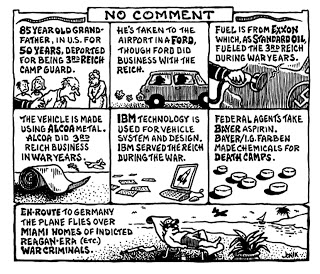
Republicans reversed FDR's values almost completely over the years.
His desire to end wars resulted in the creation of the United
Nations. He announced a Second
Bill of Rights which went into good effect in U.S. client
countries, Germany and Japan, after WWII. A Marshall Plan helped to rebuild war
devastation. New economic institutions designed at Bretton Woods
brought stability. The Universal Declaration of Human Rights was drafted by his wife, Eleanor.
There has always been a fascist minority in the US, and, over decades, they have come to control the Republican party.
All of these institutions, including major US government branches, have been undermined over the years
by Republicans, who are now destroying any socially redeeming values. They never liked the New Deal,
worked tirelessly to undermine the U. N. They demonstrated disrespect for human rights as torture,
renditions, secret prisons, and Guantanamo stained the image of the U.S. as a model
for democracy. They disdained international opinion and, for a long
time, have not signed onto widely admired agreements. Undermining elections, they have
abandoned high values that formerly brought the US respect, renewed
racism, xenophobia, militarism, empire building and slow-walked the U.S. to fascism.
We finally lost WWII.
"War is just a racket. A racket is best described, I believe, as something that is not what it seems to the majority of people. Only a small inside group knows what it is about. It is conducted for the benefit of the very few at the expense of the masses. . . " Excerpt from a speech delivered in 1933 by General Smedley Darlington Butler, USMC. General Butler was the recipient of two Congressional Medals of Honor - one of only two Marines so honored.
"I spent 33 years in the Marines. Most of my time being a high-class muscle man for Big business, for Wall Street and the bankers. In short, I was a racketeer for capitalism. I helped purify Nicaragua for the international banking house of Brown Brothers in 1909-1912. I helped make Mexico and especially Tampico safe for American oil interests in 1914. I brought light to the Dominican Republic for American sugar interests in 1916. I helped make Haiti and Cuba a decent place for the National City Bank boys to collect revenue in. I helped in the rape of half a dozen Central American republics for the benefit of Wall Street...." - Smedley D. Butler (1881-1940) Major General (U.S. Marine Corps)
The Morgan Fascist Coup Plot and How FDR Defeated It Posted on August 8, 2018 by flybynews
Republicans were then, and are now, Fascists.
They always wanted to repeal the New Deal, so Social Security,
Medicare, public education, the Post Office, public transportation, and even
public lands can be privatized and sold for profit. They have created a plutocracy, and they continue to game
the system for tax cuts, and so that democracy
may never again exist in the U.S. All of which will put us on a path
to economic instability, international hostility,
and forever wars.
Did you know America First supported the Fascist regimes in Germany and Italy. Charles Lindberg stated no help for Britian allowing the Nazis take over Great Britian. Info on You Tube.
— Peter M Gatliff (@RailroadOkie) May 14, 2021
In 1933, Retired Marine Corps Major General Smedley Butler was approached by wealthy industrialists and bankers who were plotting to create a fascist veterans organization called the "American Liberty League" and use it in a coup d'état to overthrow President Franklin D. Roosevelt, with Butler as leader of that organization. In 1934 Butler testified to the McCormack--Dickstein Congressional committee on these claims. In the opinion of the committee, these allegations were credible. One of the purported plotters, Gerald MacGuire, vehemently denied any such plot. In their report, the Congressional committee stated that it was able to confirm Butler's statements other than the proposal from MacGuire which it considered more or less confirmed by MacGuire's European reports. No one was prosecuted.
Marine Corps Maj.-Gen. Smedley Butler was approached by a wealthy and secretive group of industrialists and bankers, including Prescott Bush (George W. Bush's grandfather) who asked him to command a 500,000 strong rogue army of veterans that would help stage a coup to topple then President Franklin Delano Roosevelt.
In 1936, William Dodd, the U.S. Ambassador to Germany, wrote a letter to President Roosevelt in which he stated,
"A clique of U.S. industrialists is hell-bent to bring a fascist state to supplant our democratic government and is working closely with the fascist regime in Germany and Italy. I have had plenty of opportunity in my post in Berlin to witness how close some of our American ruling families are to the Nazi regime.... A prominent executive of one of the largest corporations, told me point blank that he would be ready to take definite action to bring fascism into America if President Roosevelt continued his progressive policies. Certain American industrialists had a great deal to do with bringing fascist regimes into being in both Germany and Italy. They extended aid to help Fascism occupy the seat of power, and they are helping to keep it there. Propagandists for fascist groups try to dismiss the fascist scare. We should be aware of the symptoms. When industrialists ignore laws designed for social and economic progress they will seek recourse to a fascist state when the institutions of our government compel them to comply with the provisions."
The proven record of Prescott Bush's involvement in financing the Nazi war machine dovetails with the fact that he was part of a criminal cabal that actively sought to impose a fascist coup in America.
President George Walker Bush's grandfather (Prescott Bush) and great grandfather (George Herbert Walker) were among Wall Street's ultra-right wing elite. Before WWII, they were among the key players who coordinated the flow of investments from American multimillionaires into Germany. They profited by helping to coordinate the American financing behind Hitler's rise to power. During the war, they even profited from companies that armed the Nazi war machine and used slave labour at Auschwitz. Then, after the war, Prescott Bush was instrumental in helping to launder Nazi loot for Fritz Thyssen, who was one Hitler's earliest and richest industrialist backers.
Document uncovers details of a planned coup
in the USA in 1933 by right-wing American businessmen.
The plotters, who were alleged to involve some of the most famous
families in America, (owners of Heinz, Birds Eye, Goodtea, Maxwell
House & George Bush's Grandfather, Prescott) believed that
their country should adopt the policies of Hitler and Mussolini to
beat the great depression. The coup was aimed at toppling President
Franklin D Roosevelt with the help of half-a-million war
veterans.
Bush's
Grandfather planned a fascist coup in America.
Mike Thomson investigates why so little is known about this biggest ever peacetime threat to American democracy.
FDR didn't just fight Fascism in WWII Europe, he fought it here at home when major corporations attempted to have him removed. His Second Bill of Rights included universal healthcare.
Franklin Roosevelt said that the domination of our nation by large corporations is the definition of fascism. http://www.rense.com/general63/ssi.htm Roosevelt wanted the Bush Family in Nuremberg Trials for funding the Nazis: one of the reasons the GOP demonize Roosevelt. http://raenergy.igc.org/FDR.html
http://www.bbc.co.uk/radio4/history/document/document_20070723.shtml
The Bush-Nazi Connection (From the NH Gazette)
Bush NAZI Connection, a collection of videos and papers.
http://www.google.com/search?sourceid=navclient&ie=UTF-8&rls=GWYA,GWYA:2005-04,GWYA:en&q=Bush+NAZI
How Bush's grandfather helped Hitler's rise to power
BBC: Bush's Grandfather Planned Fascist Coup In America
General Smedley Butler's 1935 book, "War Is a Racket,". After his retirement from the Corps, he was a popular speaker at gatherings of both veterans and pacifists.
The Plot to Overthrow FDR (video: documentary about 40 minutes.)
Vice President Henry Wallace had an equally compelling democratic vision for creating a peaceful and more equitable, nuclear-free world. Such leaders who privilege the interests of the planet above those of military and financial elites have never been more desperately needed, but, tragically, never have they been more absent. Oliver Stone and Peter Kuznick: Two Minutes and Counting (4/3/2019)
See Also: WALL STREET AND THE RISE OF HITLER By Antony C. Sutton
WW II
George Herbert Walker, grandfather of George Bush Sr. and George Bush Jr, besides being a major financier to the Nazis along with his son-in-law Prescott Bush, was also appointed supervisor of military contracts by Woodrow Wilson. Bush was in essence Hitler's banker
Bush/Nazi Link Confirmed (10/10/2003)
Video: Hitler's American Business Partners
George W Bush's grandfather also participated in the failed coup of business titans against President Roosevelt. They had planned to replace our democracy with a fascist regime modeled after Adolf Hitler's.
Let's not make the same mistake (video).
Interestingly enough, it's much easier to find out details of
the Bush family's dealings with the Nazis than it is to uncover the
simple, biographical fact that the Bush dynasty has been hardwired
into the finances of the Pentagon since Day One.
Ripping off the nation via the Pentagon is a four generation
old business for this crew.
No wonder they're so good at it. See War Profiteers.
http://www.brasschecktv.com/page/396.html
Gangsters of Capitalism by Jonathan Myerson Katz
Harry Truman (1945 to 1953)
years ago, Harry Truman replaced the old republic with a national-security state whose sole purpose Is to wage perpetual wars, hot, cold, and tepid. Exact date of replacement? February 27, 1947. Place: White House Cabinet Room. Cast: Truman, Undersecretary of State Dean Acheson, a handful of congressional leaders. Republican Senator Arthur Vandenberg told Truman that he could have his militarized economy only if he first "scared the hell out of the American people” that the Russians were coming. Truman obliged. The perpetual war began. Representative government of, by, and for the people Is now a faded memory. Only corporate America enjoys representation by the Congresses and presidents that it pays for In an arrangement where no one Is entirely accountable because those who have bought the government also own the media. Now, with the revolt of the Praetorian Guard at the Pentagon, we are entering a new and dangerous phase, Although we regularly stigmatize other societies as rogue states, we ourselves have become the largest rogue state of all. We honor no treaties. We spurn International courts, We strike unilaterally wherever we choose. We give orders, to the United Nations but do not pay our dues. We complain of terrorism, yet our empire is now the greatest terrorist of all. We bomb, invade, subvert other states. Although We the People of the United States are the sole source of legitimate authority in this land, we are no longer represented In Congress Assembled. Our Congress has been hijacked by corporate America and its enforcer, the imperial military machine. We the unrepresented People of the United States are as much victims of this militarized government as the Panamanians, Iraqis, or Somalians. We have allowed our institutions to be taken over In the name of a globalized American empire that is totally alien In concept to an our founders had in mind. I suspect that it is far too !late in the day for us to restore the republic that we lost a half-century ago. from Gore Vidal's book Perpetual War for Perpetual Peace.
Present at the Creation: Dean Acheson
Dwight Eisenhower (1953 to 1961)
the post-WWII era ... the United States, newly emerged as a superpower and embroiled in a high stakes Cold War, did not long tolerate trouble from small states, whether allies or enemies, without trying to change their leaders, preferably through the use of cloak-and-dagger covert action. The Eisenhower administration had notoriously connived at coups in both Iran (1953) and Guatemala (1954) and, less successfully, in Congo, Iraq and Indonesia. Max Boot: The Road Not Taken.
Republicans failed in their attempt to overthrow FDR, but they continued their fight against the New Deal. Eisenhower weaponized religion to undo it. (See Kevin Kruse book, One Nation Under God) and also knocked down the wall between Church and State that the originators of the Constitution clearly intended. Republicans have continued to use religion as a weapon to keep government weak and to bring back Fascism. Recent events strongly suggest we lost WWII.
The Cold War was a religious war against godless Communism, but it benefited capitalists in their crusade against labor, abetted resistance to the New Deal, inhibited social programs, and became the GOP agenda.
Demonizing Russia became the pretext for unprecedented
military expansion, an unsustainable economic bubble, and the forever war. We do not have the will to beat
our swords into plowshares, are now hooked on militarism, and cannot break the habit.
Eisenhower's warning about the Military-Industrial
complex was prescient. We are now hooked on armaments exports, military
expansion, and the military industrial complex to support the economy.
It is an addiction and may be fatal.
- War in Korea
- Overthrow of Iran
- Guatamala
- Costa Rica
- Roy Cohn
- Joseph McCarthy
McCarthy accused President Eisenhower of being a Communist.
(typical GOP, who often don't understand the word, but continue making accusations to this very day.)
Few people agreed with him. There is a brief history of McCarthyism at http://en.wikipedia.org/wiki/McCarthyism.
Notice Reagan's role below. The FBI has always been instrumental in assisting
right-wing candidates to get elected. The CIA is
also highly experienced in rigging elections.
See the film Point of Order which consists of film footage of the Army-McCarthy hearings. It appears that the Catholic Church was a force for the big red scare. The cold war was a religious war. The Vietnam War was motivated by wrong-headed, anti-Communist ideology. The Pentagon Papers showed it was a war based on lies and misunderstanding. It was a bankrupting, dismal failure. We never voted to have an empire.
Racism has been part of the Republican war on democracy, and still helps the GOP win elections through voter suppression, gerrymandering, incarceration, and other division. Republicans are a minority party so they are necessarily authoritarian, and must cheat to win elections.
The nuclear arsenal cannot coexist with democracy.
The AUMF (Authorization for the Use of Military Force) begat the forever war which represents an unconstitutional grab of war power from the Congress to the President.
HUAC (House UnAmerican Activities Commission)
JFK
Kennedy tried to topple Fidel Castro in Cuba, Patrice Lumumba in the Congo, and Rafael Trujillo in the Dominican Republic, and Diem in South Vietnam.
Bay of Pigs
Nuclear Confrontation
See Assassination page. With revelations of Howard Hunt, evidence accumulates that the CIA had a role. Bush Sr, head of the CIA, was in Dallas on that same day.
The CIA and the FBI have a history of interfering in elections.
There is a disturbing history of liberal leaders being eliminated,
especially when they threaten to bring peace.
LBJ
The Gulf
of Tonkin attack, pretext for the
Vietnam War was false.
"Pentagon Papers ... demonstrated, among other things, that the Johnson Administration "systematically lied, not only to the public but also to Congress."[3]
More specifically, the papers revealed that the U.S. secretly enlarged the scale of the Vietnam War with the bombings of nearby Cambodia and Laos, coastal raids on North Vietnam, and Marine Corps attacks, none of which were reported in the mainstream media.[4]
For his disclosure of the Pentagon Papers, Ellsberg was initially charged with conspiracy, espionage and theft of government property, but the charges were later dropped after prosecutors investigating the Watergate Scandal soon discovered that the staff members in the Nixon White House had ordered the so-called White House Plumbers to engage in unlawful efforts to discredit Ellsberg.[5]"
The Phoenix Program: America's Use of Terror in Vietnam: Douglas Valentine
Richard Nixon (1969-1974)
Nixon was a Bush protégé, hired from a newspaper ad placed by the Bushkins in 1945
Nixon was part of operation
paper clip. A collection of papers putting Nixon in the middle of smuggling the Nazis in to the GOP
after WW2. http://www.google.com/search?hl=en&rls=GWYA,GWYA:2005-04,GWYA:en&q=Nixon+Paperclip&spell=1
http://www.google.com/search?sourceid=navclient&ie=UTF-8&rls=GWYA,GWYA:2005-04,GWYA:en&q=Manhattan+Institute+Operation+Paperclip
Karl Rove and most of the PNAC cabal were Nixon CREEPs. See notes on the Bush administration and http://www.prospect.org/print/V14/2/reich-r.html
In 1968, Nixon and his operatives were determined that they wouldn’t get outmaneuvered again. As the race entered its final weeks, their great fear was that President Johnson would negotiate a settlement to the Vietnam War and thus push Vice President Hubert Humphrey over the top to victory
The evidence is now clear that the Nixon campaign dispatched Anna Chennault, a fiercely anti-communist Chinese-American, to carry that message to South Vietnamese president Nguyen van Thieu. From Consortium News
Tom Charles Huston, the national security aide assigned by
President Richard Nixon to investigate what President Lyndon Johnson
knew about why the Vietnam peace talks failed in 1968, concluded that Nixon was personally behind a secret
Republican scheme to sabotage
those negotiations whose collapse cleared the way to his narrow
victory – and to four more years of war."
READ
MORE
Richard M. Nixon told an aide that they should find a way to secretly “monkey wrench” peace talks in Vietnam in the waning days of the 1968 campaign for fear that progress toward ending the war would hurt his chances for the presidency, according to newly discovered notes. (New York Times 1/3/2017)
Richard Nixon conspired with a foreign power to win the 1968 election, enlisting the South Vietnamese to sabotage peace talks. Reagan was a race-baiter who said, during his campaign for governor, “If an individual wants to discriminate against Negroes or others in selling or renting his house, it is his right to do so.” An official from Bush’s administration — widely believed to be Karl Rove — spoke contemptuously of the “reality-based community,” prefiguring Trump’s assault on truth. Michelle Goldberg (9/3/20918)
The
GOP's History of Hostage Taking (11/6/2011)
Kissinger works both sides before the election.
Eventually, Nixon won by just 1 percent of the popular vote. “Once in office he escalated the war into Laos and Cambodia, with the loss of an additional 22,000 American lives, before finally settling for a peace agreement in 1973 that was within grasp in 1968,” says the BBC. Nixon Prolonged Vietnam War for Political Gain—And Johnson Knew About It, Newly Unclassified Tapes Suggest Nixon ran on a platform that opposed the Vietnam war, but to win the election, he needed the war to continue (3/18/2013)
Following the civil rights movement of the 1960s, state-sponsored deindustrialization and suburbanization supported white flight and hollowed out urban centers. In 1971, U.S.President Richard Nixon launched the war on drugs to intentionally disrupt urban Black communities. Incarceration quickly swelled, and jails and prisons began popping up all over the country, particularly in rural areas that were struggling to replace jobs in waning industries like farming and mining. Prison Industry: How It Started, How It Works, How It Harms (12/2020)
The World's largest prison system is an effective form of voter suppression.
Invasion by Suharto of East Timor (Amy Goodman's account)
Assassination and overthrow of Salvador Allende, and installation of Pinochet.
Wiretapping of Kissinger associates
Arrest of Pinochet in London
Judge Jaworski's opinion of Nixon: See Leon Jaworski's book: The Right and the
Power. the Prosecution of Watergate. Many of the White House staff
were indicted. Nixon, an unindicted co-conspirator, was pardoned by his
successor, Ford. His interference in
the Vietnam peace negotiations for his personal election prospects was a grave crime.
Richard Nixon turned out to be not just a very uncommon criminal himself, but he also surrounded himself with others. His senior White House staff, attorney general, and campaign staff all went to prison in connection with Watergate. His vice president, Spiro Agnew forced to step down for a bribery and extortion. Tip of a very large iceberg of spying scandals involving the intelligence community, scandals that unfolded throughout the ‘70s. Unmaking the presidency by Susan Hennessey and Benjamin Wittes pg 210
Kissinger subpoenaed in Paris
Movie: The Trial of Henry Kissinger
History and Politics Out Loud(Hear the Nixon tapes at this website.)
The Lyndon Johnson Tapes: Richard Nixon's Treason (3/15/2013)
Bibliography
American Psychosis, a Historical Investigation of How the Republican Party Went Crazy by David Corn
Burning Down the House, Newt Gingrich, the Fall of a Speaker, and the Rise of the New Republican Party By Julian E. Zelizer
A Decade of Disruption: by Garrett Peck
KISSINGER’S SHADOW, The Long Reach of America’s Most Controversial Statesman By Greg Grandin
One Man Against the World, the Tragedy of Richard Nixon: Tim Weiner
One Man Against the World: The Tragedy of Richard Nixon: Tim Weiner
The Right and the Power. the Prosecution of Watergate: Leon Jaworski
The
Nixon Defense: What He Knew and When He Knew It: John Dean
Nixon's Secrets: Roger Stone
With Liberty and Justice for Some, how the law is used to destroy equality
and protect the powerful: Glenn Greenwald
The Secret Man: Bob Woodward
All the President's Men: Bob Woodward and Carl Bernstein
The Trial of Henry Kissinger: Christopher Hitchens
Vietnam
The Fog of War (film)
Daniel Ellsberg: Why I Did It.
Ford
Nixon's resignation and subsequent pardon by hand-picked successor Ford has led
to a culture that the elite are not subject to the law.
Jimmy Carter (1977–1981)
Carter made human rights a high priority and did not start any
wars. So Republicans call him weak.
Ronald Reagan's (President from 1981–1989)
It seems to be a Republican attribute that foreign influence and war is used for political ends: Nixon sabotaged peace negotiations for Vietnam, Reagan held up release of Iranian hostages, Trump was backed by Russians.
Iranians stormed the American Embassy and took hostages. They
were held until moments after Reagan's inauguration.
in a 1980 plot – the so-called Republican “October Surprise” – to prevent the reelection of Jimmy Carter. The essence of this plot was to frustrate Carter’s efforts to repatriate the hostages seized in the U.S. Tehran Embassy, by negotiating a Republican deal with the Iranians that would be more to their liking. (The hostages in fact were returned hours after Reagan took office in 1981.) The Hidden Government Group Linking JFK, Watergate, Iran-Contra and 9/11
America's fundamental problem, in my opinion, since Ronald Reagan came to office January 20, 1981, and declared the fateful words: "Government is not the solution to our problem, Government is the problem" we have been on a more than a 30 year jag of dismantling the very means to address the challenges we face as a society .” Jeffrey Sachs CSPAN 2/17/12
When Reagan was elected president of the Screen Actors Guild, he secretly continued to help the FBI purge fellow actors from the union's rolls. Reagan's informing proved helpful to the House Un-American Activities Committee as well, since the bureau covertly passed along information that could help HUAC hold the hearings that wracked Hollywood and led to the blacklisting and ruin of many people in the film industry.,,, In the following years, Reagan and FBI officials courted each other through a series of confidential contacts. And after Reagan emerged as a leading conservative spokesman in the fifties, Hoover went beyond the bounds of his jurisdiction and secretly gave him personal and political help....the FBI's dirty tricks at Berkley helped fuel the student movement, damage the Democratic Party, launch Ronald Reagan's political career, and exacerbate the nation's continuing culture wars. Above all, it illustrates the dangers that the combination of secrecy and power pose to democracy, especially during turbulent times." from Subversives: The FBI's War on Student Radicals and Reagan's Rise to Power: Seth Rosenfeld
Reagan's initial environmental appointees were radical ant-environmentalists such as Anne Gorsuch (EPA Administrator), Bob Burford (Bureau of Land Management Director) and James Watt (interior Secretary), all drawn from the hothouse of right-wing Colorado politics. James Edwards, a South Carolina dentist, was made Secretary of Energy, with the mandate of abolishing the agency. Edwards cut the budget of DOEś CO2 program and dismissed its leader. A typical story from that time is that when GISS scientist James Hansen's research showing that the world had warmed was reported on the front page of the New York Times, DOE responded by canceling promised research funding. Climate policy was not going to be made on Reagan's watch, and research money was not going to be wasted on the environment when it could be spent on the military. Reason in a Dark Time, Why the Struggle against Climate Change Failed and What It Means For Our Future: Dale Jamieson
Killing the Messenger: CIA, Contras, And Crack (10/17/2014)
End
of the Reagan Narrative ? (11/2/2011)
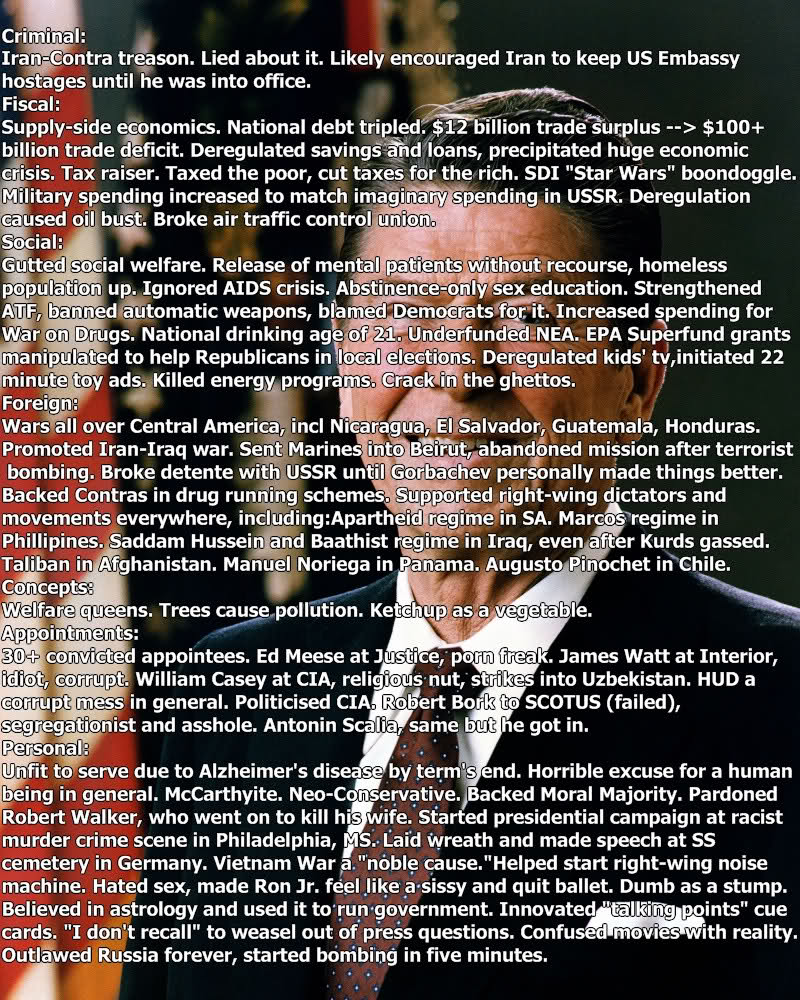
Ronald Reagan rose to the Presidency as an informer for the FBI who furnished McCarthy's HUAC with the identities of dissidents, traded arms for hostages, ran drugs into Los Angeles, waged illegal war in Central America, substantially damaged the labor movement, and achieved his office assisted by FBI surveillance., though not as intense surveillance as that brought on by the NSA under the Bush II administration.
Circumstances
appeared that the Reagan campaign made a deal with the Iranians NOT
to release the hostages until after the election.
Iran released hostages minutes after the Reagan
inauguration, and shortly after arms shipments continued. Just as Nixon
had done, Reagan interfered in foreign policy for his own personal
election prospects.
Gary Sick describes the events in his book "October Surprise". The Bush I administration stonewalled efforts to access records.
The Tricky October Surprise Report (6/18/2010)
Key October Surprise Evidence Hidden (5/6/2010)
“The Reagan-Bush years took America from the heights of a rich
creditor nation down to a pit of the world’s worst debtor nation. The
reason was weapons purchases. No other expense came close.”
— ABC 20/20 co-host Hugh Downs in an ABC Radio
commentary, March 18, 1991.
The Secret Government: The Constitution in Crisis Bill Moyers video about 1:24. Watch it on-line.
Iran-contra misuse has been well-documented. Oliver North supervised the sale of arms to Iran by using his resources as the National Security Council action officer for COG planning, under cover of a “National Program Office” that was overseen by then Vice-President George H. W. Bush. (5)North and his superiors could thus use the COG emergency network, known then as Flashboard, for the arms sales to Iran that had to be concealed from other parts of the Washington bureaucracy as well as the public. So when North had to send emergency instructions for arms delivery to the US Embassy in Lisbon, instructions that directly contravened the embargo prohibiting such sales, he used the Flashboard network to avoid alerting the Ambassador and other unwitting personnel. Peter Dale Scott
The Massive Reagan Administration Corruption.
The Sordid Contra-Cocaine Saga (10/10/2014)
How Reagan Armed the Mujahadeen in Afghanistan
Nicaragua and the World Court Ruling.
Gary Webb and the "War on Drugs"
The Power of Nightmares (BBC video) Highly recommended. You can view it on-line.
Politics of Rich and Poor: Kevin Phillips
Religion and the Cold War edited by Dianne Kirby
The thesis of Kirby's excellent introduction is that the Cold War was one of history's great religious wars, 'a global conflict between the god-fearing and the godless'. (p. 1) It was a war in which 'Christianity was appropriated by Western propagandists and policy-makers for their anti-communist arsenal' (p. 2), nowhere more so than in the USA. But in addition, as this volume demonstrates, Christianity was not simply a tool of psychological warfare. Church leaders were not merely pawns in a political game; they were active participants. Their flocks were not only recipients of propaganda; for millions religious faith was central to their lives. This fact is most vividly demonstrated in the several chapters that deal with the Catholic Church and Pope Pius XII during the early years of the Cold War.
More
The Demonization of “Big Government” and the Myth of the Greatness of Ronald Reagan
Cheney, Rumsfeld, Abrams, North,
Smiling Faces (video about 3 minutes)
Bibliography
Subversives: Seth Rosenfeld
The Man Who Sold the World, Ronald Reagan and the Betrayal of Main Street America: William KleinKnecht
Tear Down This Myth: Will Bunch
Sleepwalking Through History: Chalmers Johnson
Out of Control: Leslie Cockburn
Dark Alliance: Gary Webb
Whiteout: Jeffrey St Clair
Coverup: Behind the Iran-Contra Affair A feature length film
Bush I
Bush Sr was former head of the CIA, an
agency that secretly, systematically, undermines democratically elected
regimes for the benefit of corporate interests.
Gulf War
Air War against Iraq
"A thorough, documented, criminal indictment of George Herbert
Walker Bush, establishing beyond a reasonable doubt his guilt as a
supervisor in the conspiracy to assassinate
John F. Kennedy. You must see it to believe that former president George Herbert Walker Bush was
connected to the assassination of JFK. Once you see this documentary
though there should be no doubt in your mind that it's true. The
evidence is overwhelming and as the author of this documentary, John
Hankey says, "If we could present this evidence to a jury in Texas, he
would pay with his life". Did you know that Daddy Prescott Bush was
Hitler's chief banker in the U.S. before 1942? Did you know that George
H.W. Bush was in the CIA and in Dallas when
Kennedy was killed? This video explores the many connections between George Bush and the Kennedy
Assassination and makes a very convincing argument that he was the
operational leader of the most important coup in American history." video
S&L crisis was a small scale rehearsal for W's economic disaster.
Family of Secrets, Russ Baker
"The
Immaculate Deception: Bush Crime Family Exposed" by Russell Bowen (1992)
The Panama Deception: A feature length film
New York Times exposé of "Nayirah", the Kuwaiti diplomat's daughter who helped fake the Iraqi baby-incubator atrocity. (John MacArthur)
Second Front, Censorship and Propaganda in the Gulf War: John R. MacArthur
Bill Clinton (1993–2001)
George W. Bush (2001–2009)
An Angolan friend of Joe Wilson remarked: "One candidate loses the popular vote by over 500,000 ballots, but his brother is governor of the one state where the outcome is too close to call. The effort to count the ballots is disrupted by the Washington staffs of elected representatives from the candidate's party, and the court that ultimately adjudicates the outcome is made up largely by people appointed by the candidate's father. Sounds a lot like an election in Africa."; Joe Wilson: Politics of Truth; pg 281.
Bush v Gore was likely the worst and most devastating decision ever made by the Supreme Court.
Bush Administration Convicted of War Crimes and Crimes Against Humanity (5/30/2013)
Pretexts for the war in Iraq. were
based in fabricated evidence, some extracted by torture.
Unknown Knowns (movie)
Harold Pinter's Nobel Prize acceptance speech. (A note)
See Bush
Barack Obama (2009–2017)
Obama did little to reign in the National Security State.
Trump (2017 - 2021 )
To be elected, Nixon foiled the Vietnam Peace talks, Reagan interfered in the Iran hostage crisis, and following in the Republican tradition of manipulating foreign involvement to get elected, Trump was backed by Russia, which benefited immensely.
Like Bush before him, Trump in the 2016 election became President without winning the popular vote.
Trump is an authoritarian who is comfortable with other authoritarians, enjoys rallies of loyal supporters and military parades, funds massive military expansion and tax cuts that benefit the wealthy, announces that the press is the enemy of the people, attacks all of the institutions that allow democracy.
His appointments, mostly enemies of the agencies that they will oversee, are unprecedented hard-right, religious bigots, make prospects for peace very dark.
Republicans have been leaders in facilitating the
consolidation of corporate media
until there are only a small number of oligarchs that control most of
our information. It controls public ideology, voter
opinion, and culture. It serves the interests of the
elite creating celebrities, heroes, or even gods. It is a consequence
of concentrated media that sanitized
history finds its way into school textbooks.
It is the way the public can be distracted, depoliticized, and
dumbed-down. It covers up war crimes, imperialism, and criticism from
outside. It has become mostly trivia or propaganda. As it consolidates, it moves
to the right, toward Fascism.
Government
workings are increasingly more secret even
as people who tell the truth are punished harshly or disappeared.
Militarism has consumed resources that should have been
used for our basic maintenance. Our infrastructure is in
poor condition. Health care is th most expensive in the world and doesn't cover everyone.
Democracy is being undermined.
For decades the Presidency has become increasingly more powerful, the military
expanded relentlessly, the Congress weakened, the Justice Department and the Courts
more partisan, media more concentrated, the State Department hollowed out, surveillance universal, secrecy cloaking much of government activity,
huge floods of dark unaccountable money buying politicians, elections degraded.
According to an anonymous New York Times op-ed. there appears to be an inner circle around Trump
who are ready to override the Presidents policy. Since many in the Presidents inner circle are military,
we may be close to a military coup.
There has always been a Fascist
fringe in U.S. politics that has again surfaced with the rise of the alt-right. Racist and other tribalism
contributed to the election of Trump.
9/11 enabled the national security state and helped to both cover their
tracks and take things to a new level.
Over decades, increasingly corporate Republican Presidents, enabled by the US Supreme Court, have brought us the same attributes as Nazi Germany. With Trump's election, it appears that we lost WWII.
According to a leading EU economist, conditions are similar to those that preceded World Wars. We could be headed for WW III with much more powerful nuclear weapons in more countries.
Republicans, being climate deniers, will accelerate the destruction of the planet. They have a lot in common with Jim Jones.
Democracy has weakened slowly.
Here's a forecast.
Videos
Untold History of the United States: Oliver Stone's 12 hour series available on Netflix
(2017)
Watch the video at http://links.org.au/node/486
Links
The Massive Reagan Administration Corruption.
Bibliography
Presidential Puppetry, Obama, Romney, and Their Masters: Andrew Kreig
Conspiracy Theory in America: Lance deHaven-Smith
With Liberty and Justice for Some, how the law is used to destroy equality and protect the powerful: Glenn Greenwald
George W Bush, War Criminal ? Michael Haas
When Presidents Lie, A History of Official Deception and Its Consequences,
Eric Alterman
American Conspiracies: Jesse Ventura
Family of Secrets: Russ Baker (Note)
The CIA's Greatest Hits: Mark Zepezauer, Odonian Press
People's
History of the United States: Howard Zinn (see this on-line version)
Since its landmark publication in 1980, /A Peoples History of the
United States/ has had six new editions, sold more than 1.7 million
copies and been turned into an acclaimed play. More than a successful
book, /A Peoples History/ triggered a revolution in the way history is
told, displacing the official versions with their emphasis on great men
in high places to chronicle events as they were lived, from the bottom up.
Now Howard Zinn, historian Paul Buhle, and cartoonist Mike
Konopacki
have collaborated to retell, in vibrant comics form, a most
immediate
and relevant chapter of /A Peoples History/: the centuries-long
story
of America's actions in the world. This short animated
video explores US expansionism from Wounded Knee to the invasion
of
Iraq, stopping along the way at World War I, World War II
Central America, Vietnam and the Iranian revolution.
Supplying Repression: U.S. Support for Authoritarian Regimes Abroad - Page 98by Michael
T. Klare, Cynthia Arnson,
Institute for Policy Studies, Delia Miller, Daniel Volman - Political
Science - 1981 - 165 pages ... Michael T ...
Klare ...
|