Military
The Wasteful and Ever-Expanding War Machine avoids DOGE’s Axe (4/23/2025)
Why I’m voting against the military budget Bernie Sanders (12/8/2024)
Trump Pentagon pick attacks UN and Nato and urges US to ignore Geneva conventions (11/25/2024)
13 Ex-Trump Aides Back Kelly’s ‘Dictator’ Warning, Saying Trump Seeks ‘Absolute, Unchecked Power’ (10/25/2024)
Harris decries Trump after John Kelly says he wanted generals like Hitler’s (10/23/2024)
John Kelly goes on the record to confirm several disturbing stories about Trump
‘Profoundly ahistorical’: 4-star generals side with Jack Smith, tell Supreme Court Trump’s immunity claims are ‘assault’ on democracy (4/9/2024)

It is not hard to see why Trump wants Hegseth as his secretary of defense. Trump plans to purge the armed forces of high officers who care about the United States and leave only loyalists. Trump wants to use the armed forces in operations inside the United States, including the oppression of “enemies within,” which is to say, his political opponents. Hegseth gives every sign of being a person who would embrace such actions as an American crusade. The Crusade against America by Timothy Snyder (11/22/2024)
During Donald Trump’s first term, the military faced multiple challenges from its commander-in-chief. Trump and his staff tried to drag the military into partisan politics, positioning uniformed personnel at campaign events and the 2020 GOP convention. He requested that the name of the Naval ship USS McCain be covered up due to his distaste for a certain senator. He demanded a North Korean-style military parade on the Fourth of July. He benefited from the military unethically spending money at his properties. And Trump, who dubiously avoided serving in Vietnam, voiced disdain for service members, including the dead and wounded. The Fire Next Time (1/19/2024)
Trump & Musk want to fire 83,000 employees from the Veterans Administration.
— Bernie Sanders (@BernieSanders) March 18, 2025
That means the quality of veterans' health care will deteriorate, and they will wait even longer for benefits.
You do NOT balance the budget on the backs of men & women who defended this country. pic.twitter.com/IXC65dIbvl
Some of the most prominent and judicious strategic analysts in the United States warn of "ultimate doom" or even "apocalypse soon" if the government persists in its aggressive militarism -- and looming not too far in the distance is the threat of anthropogenic environmental catastrophe. (Noam Chomsky: Hopes and Prospects. pg 4)
Our military organization today bears little relation to that known by any of my predecessors in peacetime, or indeed by the fighting men of World War II or Korea. Until the latest of our world conflicts, the United States had no armaments industry. American makers of plowshares could, with time and as required, make swords as well. But now we can no longer risk emergency improvisation of national defense; we have been compelled to create a permanent armaments industry of vast proportions. Added to this, three and a half million men and women are directly engaged in the defense establishment. We annually spend on military security more than the net income of all United States corporations. This conjunction of an immense military establishment and a large arms industry is new in the American experience. The total influence -- economic, political, even spiritual -- is felt in every city, every State house, every office of the Federal government. We recognize the imperative need for this development. Yet we must not fail to comprehend its grave implications. Our toil, resources and livelihood are all involved; so is the very structure of our society. In the councils of government, we must guard against the acquisition of unwarranted influence, whether sought or unsought, by the military-industrial complex. The potential for the disastrous rise of misplaced power exists and will persist.
Dwight Eisenhower 1961
... the interests [of most states] are demonstrably at variance with those of their people. Defense spending is an obvious example. In most countries, from the democratic superpower to the tinpot military dictatorship, the confluence of interests which Dwight Eisenhower called the military-industrial complex exercises inordinate power over government, and money which should be spent, for example, on public health and education, is instead spent on unnecessary weapons... states tacitly conspire against their peoples. George Monbiot in Manifesto for a new World Order
One might even argue that capitalism often resolves systemic economic crises through war. After all, a war economy with militarisation, mobilisation, full employment and jingoism can be viewed as the ultimate solution to economic woes and social unrest. The transition of Western democracy to oligarchy and the descent into soft fascism is under way. Citizens will need to participate actively, rather than as passive consumers, to demand an end to this cycle of violence from governments and to defend the assault on democratic processes. World war 3 is coming...
"If you’re worried about the deficit, pay attention to the fact that it’s almost all attributable to military spending and the totally dysfunctional health program." Noam Chomsky
“Were the Soviet Union to sink tomorrow under the waters of the ocean, the American military-industrial establishment would have to go on, substantially unchanged, until some other adversary could be invented. Anything else would be an unacceptable shock to the American economy.” ― George F. Kennan
the Pentagon System functions as a great form of domestic corporate welfare for high-tech “defense” (empire) firms like Lockheed Martin, Boeing, and Raytheon—this while it steals trillions of dollars that might otherwise in meeting social and environmental needs at home and abroad. It is a significant mode of upward wealth distribution within “the homeland.” from a book review of In the Shadows of the American Century: The Rise and Decline of US Global Power
Blunt, plain spoken words from Ben Hodges, Commanding General United States Army Europe (Retired) and Florida Panhandle native (Quincy, FL) on his decision to endorse Harris for President:
— JP (@DirtRoadPickup) September 22, 2024
"The choice has never been clearer. DJT is a threat to democracy, has disdain for our… pic.twitter.com/nxITY7zwdX
But Why ? Why have we done it ? Why on a planet that has an exploding population, a deteriorating environment, and massive social problems, has the only genuinely creative species invested so much time, energy, and genius in building arsenals that can only be used to destroy itself ?" New World New Mind: Robert Ornstein and Paul Ehrlich
“The Pentagon budget – which jumped more than $130 billion during the Trump presidency — is replete with spending on overpriced weapons that don’t work, rip-off deals for private contractors, gigantic investments in pointless or outdated weapons systems, and waste and mismanagement so severe the agency cannot pass an audit. It is, indeed, a tribute to the power of the military-industrial complex. Public Citizen president, Robert Weissman (4/8/2021
🚨NEW: Vivek Ramaswamay, an incoming member of the Trump Administration, has announced plans to cut $120 billion in Veterans health care.
— Morgan J. Freeman (@mjfree) November 15, 2024
RETWEET to let the American people know what they voted for! pic.twitter.com/4aDE2uBmPM
Here’s a handy list of veterans bills that Republicans have blocked over the last six years.
— Nick Knudsen 🇺🇸 (@NickKnudsenUS) June 6, 2024
You can put this in their replies when they talk about todays’s D-Day anniversary. #FreedomOverFascism pic.twitter.com/vZUIcgKpbz
It’s soon approaching 9 months that Tommy Tuberville has deliberately blocked military promotions leaving two branches of US military without Senate-confirmed leaders. This is an assault on national security.
— Ricky Davila (@TheRickyDavila) August 9, 2023
The face of a fascist traitor. pic.twitter.com/pEmiANNbkE
And He shall judge among the nations, and shall rebuke many people: and they shall beat their swords into plowshares, and their spears into pruning hooks: nation shall not lift up sword against nation, neither shall they learn war any more.—Isaiah 2:3–4
Replicator, planes and multi-year deals: What’s in the new FY24 defense spending bill (3/2024)
Fmr. Naval professor: Trump seeks 'authoritarian control' of military to 'put down opposition' (12/8/2023)
Tommy Tuberville is not acting: he really is Trump’s useful idiot (11/7/2023)
Is Tuberville’s Senate Hold on Military Promotions So Trump Can Fill Them in 2025? (7/28/2023)
What a Waste, and You’re Paying for it: $778 Billion for the Pentagon and Still Counting (2/4/2020) William D. Hartung
BOOM: Here is the clip of Donald Trump’s Chief of Staff CONFIRMING that Trump called fallen American soldiers “losers and suckers.” This is damning. Repost and spread this everywhere. pic.twitter.com/ew9U8s28wi
— Harry Sisson (@harryjsisson) June 28, 2024
Republicans don’t care about Veterans. The RNC Chair in West Virginia called my military retirement a “Welfare Check”. No veteran should vote for these jackaloons. pic.twitter.com/i8SjVDPPXD
— Richard N. Ojeda, II (@Ojeda4America) May 25, 2024
Republicans excel at paying lip service to veterans.
— Tony 🌊 #DemVoice1 (@TonyHussein4) May 23, 2022
But their voting record proves that they don't care.
The ONLY reason Republicans perform better with veterans at elections, is because they communicate better with them, by email and on right-wing media.#DemVoice1 #Fresh pic.twitter.com/7gXuRgNYrg
US rejects calls for regulating or banning ‘killer robots’ (12/2/2021)
Over the 20 years since 9/11, the U.S. has spent $21 trillion on foreign and domestic militarization. (9/2021)
Top generals feared Trump would attempt coup after election: book (7/14/2021)
U.S. Defense Spending Compared to Other Countries (7/9/2021)
Want Socialism? Try the U.S. Military. (6/18/2021)
Pentagon report cites threat of extremism in military (3/2/2021) AP News
Let’s Cut Our Ridiculous Defense Budget (4/7/2021)
50 House Lawmakers Are Right: Excessive Pentagon Spending Won’t Make Us Safer (3/16/2021)
The Militarization of American Democracy (2/4/2021)
‘Trump Has Let the Military Establishment Do Everything It Wants to Do’ (11/29/2020)
Has Trump’s last-minute Purge of Defense Agencies Put America in Danger? (11/22/2020)
Why 780 retired generals and former national security leaders spoke out against Trump (10/21/2020)
It’s Time to Rein in Inflated Military Budgets (9/14/2020)
Most Americans have no idea how deeply entwined white supremacist groups are in the military (10/10/2020)
It’s Time to Cut the Bloated Pentagon Budget to Fund People, Not Military Contractors (7/4/2020)
Beware the Pentagon’s Pandemic Profiteers (05/05/2020)
Letting the Pentagon Loose With Your Tax Dollars (3/1/2020)
National Security Legislative Calendar
Center for Defense Information
Center For Arms Control And Non_Proliferation
Military Religious Freedom Foundation
School of Americas Watch ...See this video.
Mandatory Christianity in the military
Alliance for Nuclear Accountability
Trump ordered the pentagon to take away $62 million given to Fort Campbell Kentucky for a new middle school on post.
— Emmyjo (@Road_trippn) February 16, 2020
The middle school project is one of 127 military projects
on the chopping block.
(Still think he loves his military?) 127 more military projects SCRAPPED!
Benedict Trump? https://t.co/B11faoOCOV
— Laurence Tribe (@tribelaw) July 3, 2020
The legal scholar Bruce Ackerman has characterized the last fifty years of American presidential politics as a series of power-grabs by the executive. The biggest involves the politicization of he military, which has been increasingly co-opted into executive rule. Faced with a recalcitrant Congress, presidents turn to soldiers to get things done. Ackerman sees two dangers. One is that a subservient high command might greatly expand the powers of an extremist presidency by doing what it is told. The other is that the president ends up doing what he is told by his generals, who have become an indispensable part of he administration. The commander-in-chief then becomes a figurehead for what is essentially military rule. Are the generals obeying politicians or the politicians obeying generals ? Once the lines get blurred, it is hard to know for sure. How Democracy Ends: David Runciman
We spend almost $1 trillion annually on defense. Have you ever heard any politician screaming about debt, deficit or inflation? But a bill that invests in childcare, early education, economic security for seniors & planet saving measures will destroy our USA. Gaslighting SUCKS.
— George#VotesBlueAlways (@Numbers28) October 18, 2021
Trump to Withdraw From ‘Open Skies’ Arms Control Treaty (5/21/2020)
VA Instructs Coronavirus-Exposed Staff to Continue Working, Places Those Who Don’t in AWOL Status (4/17/2020)
Poverty is the draft. pic.twitter.com/RpgLxOYwqq
— Heidi Sloan (@HeidiSloanForTX) January 9, 2020
When Eisenhower warned of the Military Industrial Complex, he was thinking about physical weapons. But, just as unregulated semi-automatics invented for soldiers end up going off in American schools, it shouldn't be any kind of surprise that the weapons of information war are going off in Anglo-American votes. Cambridge Analytica is what happens when you privatise military propaganda: Adam Ramsay (3/28/2018)
Each year, lawmakers and defense lobbyists play the same game, pouring hundreds of billions into the Pentagon without scrutinizing every dollar—and it's taxpayers who lose.
— Rep. Katie Porter (@RepKatiePorter) July 13, 2023
Today, I invited witnesses to play JeoparDoD, to win oversight for the American people. pic.twitter.com/s8Y2ZqNxLj
hey, remember when Trump honored our nation's military? me neither, but I do remember when he lied about raising their pay, attacked Gold Star parents, called a war widow a liar, mocked a POW, pardoned a war criminal and fired Alex Vindman. oh, and he fucking dodged the draft too
— Jeff Tiedrich (@itsJeffTiedrich) February 8, 2020
Military becoming not merely domesticated and bought off but radicalized: very dangerous for civil society, very good for leader who may call on them at right(wing) moment. Sad ppl like Mattis who sold out are staying silent. #SundayThoughts https://t.co/YzNJok4e4L
— Ruth Ben-Ghiat (@ruthbenghiat) October 6, 2019
We’re treating each other like we treat the rest of the world pic.twitter.com/EGcI8tx7i6
— Scott Shapiro, Grandma Killer (@scottjshapiro) June 3, 2020
With its billions of dollars layered on hundreds of weapon systems, the US defense budget has itself become a weapon of mass destruction, decimating our social programs and infrastructure. Republicans have no problem with this arrangement. Say a Farewell to Arms (7/2018)
Trump ends US military ban on using landmines https://t.co/4NiwyYKxtN
— Ming Solenya Nethery (@MingGao26) January 31, 2020
the Pentagon System functions as a great form of domestic corporate welfare for high-tech “defense” (empire) firms like Lockheed Martin, Boeing, and Raytheon—this while it steals trillions of dollars that might otherwise in meeting social and environmental needs at home and abroad. It is a significant mode of upward wealth distribution within “the homeland.” from a book review of In the Shadows of the American Century: The Rise and Decline of US Global Power
"The United States Military is being taken over by evangelical Christians who are more loyal to their religion than the constitution"https://t.co/l504w83A03
— notWhyz (@notWhyz) January 27, 2020
— ✍🏻This is no dream! This is really happening! (@WWonTwit) September 27, 2021
Erosion by Deference: Civilian Control and the Military in Policymaking (6/2020)
Warriors and Citizens: American Views of Our Military by Jim Mattis, Kori N. Schake
Why Does the U.S. Military Celebrate White Supremacy? (5/23/2020)
The Savage Injustice of Trump’s Military Pardons (12/4/2019)
Our Republic Is Under Attack From the President: Admiral McRaven is a former commander of the United States Special Operations Command. (10/17/2019)
The Military-Industrial Virus, How bloated defense budgets gut our armed forces (6/2019 issue of Harpers Magazine)
Trump’s Pentagon choice fights to win over doubters (6/14/2019)
Growth in Global Arms Transfers and Military Spending (5/6/2019)
Pentagon plans tests of long-banned types of missiles (3/13/2019)
For Military in 2017, taxpayers in the United States are paying $647 billion. Here's what those tax dollars could have paid for instead:
How to Blow $700 Billion and Lose Wars: A Guide to America's Exploding Defense Budget and Military Failure (9/1/2018)
Trump’s “Space Force”: More ‘Whitey on the Moon’ (8/12/2018)
William Hartung, Weaponized Keynesianism in Washington (7/1/2018)
Wilkerson: From Trump Parade to Budget, There's 'Too Much Military' (2/12/2018)
Over Six Trillion Dollars in Unaccountable Army Spending (10/4/2017)
US Provides Military Aid To More Than 70 Percent Of World’s Dictatorships (9/27/2017)
The U.S. Still Leans on the Military-Industrial Complex (9/22/2017)
The Department of Defense has trained more than a hundred foreign militaries that went on to stage coups in their home countries. (8/11/2017)
Investing in the Military ... and little else (2/2/2017)
This is strong but warranted. We are unilaterally disarming in the face of cyber attacks from Russia and others. There is a fundamental inconsistency between Republican support for a large defense budget and their refusal to back needed cyber defenses. https://t.co/7vksPn77Lv
— Richard N. Haass (@RichardHaass) July 27, 2019
Sixty years after World War II, the military industries and the Pentagon secured dominance over Congress, the White House, and the news media. This has never been more apparent than in the invasion of Iraq and the so-called War on Terror. (From the Preface of a Political Odyssey: The Rise of American Militarism and one Man's Fight to Stop It. Senator Mike Gravel and Joe Lauria.)
Moral bankruptcy. pic.twitter.com/2KihwnO8Sf
— Jeffrey Levin (@jilevin) October 3, 2021
...with the exception of Bernie Sanders, all the presidential candidates, Democrat and Republican, want our military to be as big as it is or bigger. While Hillary Clinton hasn't yet made any campaign statements about the military budget, she's always been known as among the most hawkish of Democrats, so it would be shocking if she proposed defense cuts. Even Rand Paul supports an increase in the military budget; the only question among the other Republican candidates is who wants to increase spending the most." The American Prospect (5/18/2015)
. . . the Big Dick School of Patriotism is invested in keeping only one “branch” of government functional: the U.S. military and the national security state that goes with it, even as it trumpets constant terrors and threats this country must face: America's New Military Mystique
By a process of self-selection, acculturation, and groupthink, a majority of the members of Congress currently sitting on the defense committees of both the House and Senate have become rigid advocates of ever higher military spending, even when this position conflicts with their much-advertised insistence on the need to rein in the national debt and their tiresome and hypocritical rhetorical claims that we must not leave fiscal burdens on the backs on our children. The Party is Over: Mike Lofgren
"In the councils of government, we must guard against the acquisition of unwarrented influence, whether sought or unsought, by the military-industrial complex." Dwight Eisenhower.
If Eisenhower were giving his famous Farewell Address today, he would have to revise it and call it the Military-Industrial-Congressional-Contracting complex, to be accurate. Lobelog
Between 1940 and 1996, for instance, the United States spent nearly $4.5 trillion on the development, testing and construction of nuclear weapons alone. By 1967, the peak year of its nuclear stockpile, the United States possessed some 32,000 deliverable bombs. None of them was ever used, which illustrates perfectly Keynes's observation that, in order to create jobs, the government might as well decide to bury money in old mines and "leave them to private enterprise on the well-tried principles of laissez faire to dig them up again". Nuclear bombs were not just America's secret weapon; they were also a secret economic weapon....
To understand the real weight of military of the United States-that is, the reported budget of the Department of Defense- does not include: The Department of Energy's spending on nuclear weapons ($16.4 billion slated for fiscal 2006), the Department of Homeland Security's outlays for the actual *defense* of the United States ($41 billion) or the Department of Veteran's Affairs responsibilities for the lifetime care of the seriously wounded ($68 billion). Nor does it include the billions of dollars the Department of State spends each year to finance foreign arms sales and militarily related development or the Treasury Department's payments of pensions to military retirees and widows and their families (an amount not fully disclosed by official statistics). Still to be added are interest payments by the Treasury to cover past debt-financed defense outlays. The economist Robert Higgs estimates that in 2002 such interest payments amounted to $138.7 billion. Chalmers Johnson, Harpers Magazine 2007
... how the Military-Industrial Complex has worked for decades: think-tank analysts generate the reasons for military spending, the government bureaucrats implement the necessary war policies, and the military contractors make lots of money before kicking back some to the think tanks — so the bloody but profitable cycle can spin again. Robert Parry, Consortium News (3/22/2015)
The salute of all things military — and the quick denunciation of any who dare question it — has become a knee-jerk part of American life. It strikes me as a cynical ploy to ensure that the military-industrial-Congressional-entertainment complex is perpetually well fed, even as spending on the rest of society is cut and the debt balloons. Glenn Baker
Suppose China spent more on its military than every other nation combined, built hundreds of overseas garrisons, played aggressive war games, and partitioned the planet into "command sectors," all while claiming its goal was world peace and stability. Hey wait, that's us. (from a Mother Jones review of Washington Rules: Americas Path to Permanent War by Andrew J. Bacevich.
"...US military spending equals that of the next fifteen countries combined (most of them allies) and represents 47 percent of total global military spending. If Washington's mindset were different, it wouldn't be hard to find that $100 billion the Republican House freshmen are looking for in the Pentagon budget alone -- quite aside from cuts in supplemental war-fighting funds -- and still be the most heavily armed nation on the planet." from the United States of Fear, Tom Engelhardt (pg 140)
"Like an alcoholic on a bender, the present Pentagon and military cast of characters can't stop themselves. Forever war is in their blood, so much so that they're ready to face down the commander in chief, if necessary, to make it continue. This is really the definition of an addiction - not to victory, but to the state of war itself. Don't expect them to discipline themselves. They won't." The United States of Fear: Tom Englehardt
Whose military is stronger.
— ༺❆ᗙ Martin 🏳️🌈 ᗛ❆༻ Party time🍷 (@KlatuBaradaNiko) November 19, 2020
Infographics covering the period from 1816 to 2020
pic.twitter.com/E27rVObFfZ
"That U.S. military budget exceeds what the rest of the world’s nations combined spend on defense. Nor can it be justified as militarily necessary to counter terrorists, who used primitive $10 box cutters to commandeer civilian aircraft on 9/11. It only makes sense as a field of dreams for defense contractors and their allies in Washington who seized upon the 9/11 tragedy to invent a new Cold War. Imagine their panic at the end of the old one and their glee at this newfound opportunity. Ike was right: Robert Scheer"
..."We've been trying to educate some of the members of Congress that there are a lot more direct ways to help thier districts. If you support the F-22 based on jobs in your district, you're trying to recruit a coalition. Somebody says, I'll support you on the F-22 if you support me on the F-18. And I'll support you on missile defense if you support me nuclear weapons. Next thing you know, they've woven together this coalition of death. It's not just the cost of that one plane, it's the cost of doing business that way, allowing the Pentagon and its contractors to sort out the budget and the economy." William Hartung quoted in Loving This Planet, Helen Caldicott
"What if the Republican Party had a real debate on Pentagon spending that addressed the underlying issue of what our military is for? Should we be poised to fight major wars of occupation and/or counterinsurgency like those in Iraq and Afghanistan? Do we need 700-plus foreign military bases? Why are we investing in new nuclear bomb facilities, bombers and submarines at a time when maintaining the U.S. arsenal at current levels serves no useful purpose? It's probably too late for that to happen this year, on the verge of a presidential election, but it would be both refreshing and responsible if it were to happen in the years to come." William Hartung
During the 1970s and 1980s, there emerged in the United States a group of leading military-dependent corporations. We call them the Arma-Core. Faced with mounting foreign competition, these firms have gradually retreated into the shelter of government contracts and subsidies, disguised under the aggregate fiscal policy of ‘military Keynesianism’. ...The final piece in the puzzle was the new source of financing for the weapon trade: Middle-East oil. Until the early 1970s, the primary destination of global arms exports was South-East Asia. But the politicization of oil, the attendant ‘energy conflicts’ (fuelled by imported weapons), the resulting ‘oil crisis’ and the happy surge in OPEC’s oil revenues conspired to shift the focus. Soon enough, the Middle East became the world’s leading market for imported weapons." The Scientist and the Church, Nitzan and Bichler
And He shall judge among the nations, and shall rebuke many people: and they shall beat their swords into plowshares, and their spears into pruning hooks: nation shall not lift up sword against nation, neither shall they learn war any more.—Isaiah 2:3–4

Cow
Most Sacred: Why Military Spending Remains Untouchable (8/20/2016)
If the Military had Permission to Speak Freely: They might rescue us from the Politicians’ Forever War (8/12/2016)
How to Arm a "Volatile" Planet (7/26/2016)
The
problem with US military strategy is that it doesn’t fix any of the
problems it’s setting out to address. (2/25/2016)
Why
the Deafening Silence on Cutting the Military Budget? (2/22/2016)
Why
PolitiFact Is Wrong About Sanders' Criticism of the Pentagon Budget
(1/20/2016)
US
Military Forces Deployed in 70% of All World’s Nations (12/16/2015)
Time to Hold Military Boots to the Fire (8/18/2015)
Pentagon remains stubbornly unable to account for its billions (8/3/2015)
Andrew
Bacevich, The Theology of American National Security (6/18/2015)
Summary
of Fiscal Year 2016 National Defense Authorization Act As Reported by
House Armed Services (5/6/2015)
The
Biggest Threat to American Liberty (4/1/2015)
The
Tragedy of the American Military (1/2015)
The Limits of US Military Power (5/14/2014)
A
Militarism we call Patriotism (3/9/2014)
The
Menace of the Military Mind (2/3/2014)
The
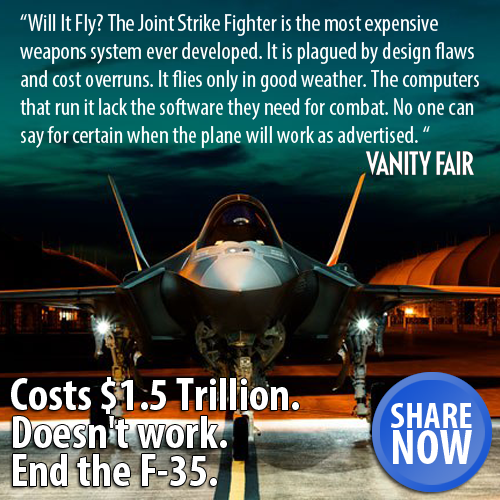
F-35's History of Costly Problems (9/29/2013)
What's
Being Cut: So Far Not Pentagon Contractors Profits
(5/1/2013)
The
Blind Theology of Militarism (2/15/2013)
The Real Reason Republicans Hate Hagel (1/6/2013)
The Army Doesn't Want More Tanks, But Congress Does (10/9/2012)
The
Pentagon President (9/2012)
U.S. Military Still Using "Jesus Rifles" in Afghanistan (9/27/2012)
Majorities in Both Red and Blue Districts Favor Deep Cuts in Defense Spending (7/16/2012)
The Romney-Cheney Doctrine (7/2012)
Washington's
Militarized Mindset (7/5/2012)
Benefits
of a Slimmer Pentagon (5/28/2012)
To Protect the Military budget, House GOP plans to cut 25% from Programs that directly benefit the poor. (5/7/2012)
Hollywood Glorifies Military at Taxpayers’ Expense (8/2011)
Fighting the Poverty Draft
Why don't we donate military services to African wildlife refuges to capture or kill poachers? We can do the same for fishing-factory ships that violate international agreements on catch-quotas. IMHO, that would be a wonderful opportunity to help endangered species and also gain outstanding public relations for our military. Jay Hanson
Republicans are increasing the budget for the world's largest military. They are the party of the military-industrial-congressional complex, war profiteers, war mongers, and have dreams of world dominating empire. Electing them guarantees loss of democracy, civil liberties. Ratcheting up of security, secrecy, universal surveillance, and a militarized, police state.
Not coincidentally, the US is also the world's largest
arms supplier. As a result, the arms industry is well
funded and powerful. The
NRA is its subsidiary.
The arms industry, recipient of the blank check from the US taxpayer, is the leading cheerleader for
our endless war. It uses the same
tactics that the tobacco industry developed to sell arms to the
citizenry. The US by comparison to other countries has, as a
result, become a shooting gallery. Safety is NOT improved, nor is
it a real issue.
We have a new arms race: police vs people, both armed with advanced weapons. In response, police have been militarized.
The Bush family for generations has
had close, profitable ties to the Pentagon. and their wars motivated terrorism.
The US, In spite of agreements formerly signed, has
embarked on a trillion dollar overhaul of nuclear
weapons.
If the US abandons its dream of empire,
it can wind down its military, be safer, preserve civil liberties
winding down the national security
state,
solve domestic problems, and enhance civilization. The Republican
Congress will allow none of it.
The world's largest military has
often been used to make other countries safe for corporate investors, remove
democratically elected governments, and install brutal dictators
by force. The CIA has a long record of
supporting this activity. War has been used as a
political instrument to win
Presidential elections. During the Cold War Russians were demonized to justify outlandish
funding for the military.
How
Safe Are You: What Almost 8 Trillion Dollars in National
Security Spending Bought You (8/16/2011)
Defense
Industry: Keep Paying Us or the Economy Dies
(10/27/2010)
About the Military-Industrial-Congressional Complex (Robert Reich) 2 minute video
The
Pentagon's Spending Spree (8/16/2011)
Why We Fight (Video)
“War is just a racket. A racket is best described, I believe, as something that is not what it seems to the majority of people. Only a small inside group knows what it is about. It is conducted for the benefit of the very few at the expense of the masses.
I believe in adequate defense at the coastline and nothing else. If a nation comes over here to fight, then we'll fight. The trouble with America is that when the dollar only earns 6 percent over here, then it gets restless and goes overseas to get 100 percent. Then the flag follows the dollar and the soldiers follow the flag.
I wouldn't go to war again as I have done to protect some lousy investment of the bankers. There are only two things we should fight for. One is the defense of our homes and the other is the Bill of Rights. War for any other reason is simply a racket.
There isn't a trick in the racketeering bag that the military gang is blind to. It has its "finger men" to point out enemies, its "muscle men" to destroy enemies, its "brain men" to plan war preparations, and a "Big Boss" Super-Nationalistic-Capitalism.
It may seem odd for me, a military man to adopt such a comparison. Truthfulness compels me to. I spent thirty- three years and four months in active military service as a member of this country's most agile military force, the Marine Corps. I served in all commissioned ranks from Second Lieutenant to Major-General. And during that period, I spent most of my time being a high class muscle- man for Big Business, for Wall Street and for the Bankers. In short, I was a racketeer, a gangster for capitalism.
I suspected I was just part of a racket at the time. Now I am sure of it. Like all the members of the military profession, I never had a thought of my own until I left the service. My mental faculties remained in suspended animation while I obeyed the orders of higher-ups. This is typical with everyone in the military service.
I helped make Mexico, especially Tampico, safe for American oil interests in 1914. I helped make Haiti and Cuba a decent place for the National City Bank boys to collect revenues in. I helped in the raping of half a dozen Central American republics for the benefits of Wall Street. The record of racketeering is long. I helped purify Nicaragua for the international banking house of Brown Brothers in 1909-1912. I brought light to the Dominican Republic for American sugar interests in 1916. In China I helped to see to it that Standard Oil went its way unmolested.
During those years, I had, as the boys in the back room would say, a swell racket. Looking back on it, I feel that I could have given Al Capone a few hints. The best he could do was to operate his racket in three districts. I operated on three continents.”
Excerpt from a speech delivered in 1933, by Major General Smedley Butler, USMC
More about Gen. Smedley Butler
Republican Math And The Pentagon Budget (3/20/2012)
The Vast And Expansive US Secret Army (9/2/2011)
Defense needs to do its part in the Deficit Debate (7/28/11)
Eisenhower's Farewell Address to the Nation (1/17/1961)
Despite whatever theories strategists may spin, the defense budget is now, to a large degree, a jobs program. It is also a cash cow that provides billions of dollars for corporations, lobbyists, and special interest groups. Ronald Steel: Temptations of a Superpower, 1995.
"The American military has been transformed into a “global oil-protection service” for the benefit of U.S. corporations and consumers, fighting overseas battles and establishing its bases to ensure that we get our daily fuel fix." Michael Klare, professor of Peace and World Security Studies at Hampshire College.
Every gun that is made, every warship launched, every rocket fired signifies, in the final sense, a theft from those who hunger and are not fed, those who are cold and are not clothed. This world in arms is not spending money alone. It is spending the sweat of laborers, the genius of scientists, the hopes of its children. -- Dwight Eisenhower, U.S. President and General
The exercise of military power will not enable the United States to evade the predicament to which the crisis of profligacy has given rise. To persist in following that path is to invite inevitable overextension, bankruptcy and ruin. The Limits of Power, the End of American Exceptionalism: Andrew J. Bacevich
The second prevailing dogma of our time is aggressive militarism, of which the new policy of preemptive strike against potential enemies is but an extension. This new doctrine of U.S. foreign policy goes far beyond our former doctrine of preventive war. It green-lights political elites to sacrifice U.S. soldiers—who are disproportionately working class and youth of color—in adventurous crusades. This dogma posits military might as salvific in a world in which he who has the most and biggest weapons is the most moral and masculine, hence worthy of policing others. In practice, this dogma takes the form of unilateral intervention, colonial invasion, and armed occupation abroad. It has fueled a foreign policy that shuns multilateral cooperation of nations and undermines international structures of deliberation. Fashioned out of the cowboy mythology of the American frontier fantasy, the dogma of aggressive militarism is a lone-ranger strategy that employs “spare-no-enemies” tactics. It guarantees a perennial resorting to the immoral and base manner of settling conflict, namely, the perpetration of the very sick and cowardly terrorism it claims to contain and eliminate. On the domestic front, this dogma expands police power, augments the prison-industrial complex, and legitimates unchecked male power (and violence) at home and in the workplace. It views crime as a monstrous enemy to crush (targeting poor people) rather than as an ugly behavior to change (by addressing the conditions that often encourage such behavior). Cornel West: Democracy Matters
The Military-Industrial Complex's Win (7/7/2010)
The War is Making You Poor (6/11/2010)
Just Don't Call It Defense(5/7/2010)
Why We Must Reduce Military Spending (7/6/2010)
The US spends more on the military than the rest of the world combined. US troops are deployed worldwide. (Some listed here) How much do Americans know about this ?
The military-industrial complex consumes most of our resources. Mike Gravel put it this way in his fine book, A Political Odyssey:
Wasteful defense spending has helped bring us failing schools, crumbling physical infrastructure, a backward national rail system, 47 million Americans without health insurance, and 37 million living in poverty. Cutting the defense budget in half would do nothing to undermine our security and that giant sound you'd hear would be the sigh of relief from a suffering world. Then we could concentrate those resources on solving our disgraceful problems at home."
All those billions did nothing to stop a few determined individuals with box cutters.
The economy has been militarized, war profiteering is public and visible, the military-industrial complex rules yet, since the media does not regard it as a story, it is not in the public mind. Important news programs are frequently sponsored by defense contractors. Resources used for the military are lost forever. Bush’s gratuitous wars drained our remaining economic strength. We did not learn the lessons of Vietnam.
The military is pure socialism at its most complete. It
provides food, clothes, shelter, healthcare, training, arms, and a command
structure that makes all but the very top level decisions. (It
still doesn't entirely determine when to go to war.) Although Republicans deplore socialism, they
can't do enough for the military. From other countries, we have many
examples when civilian government becomes dysfunctional enough, the
military takes control. Could that happen here in the U.S. ? Who is
watching ?
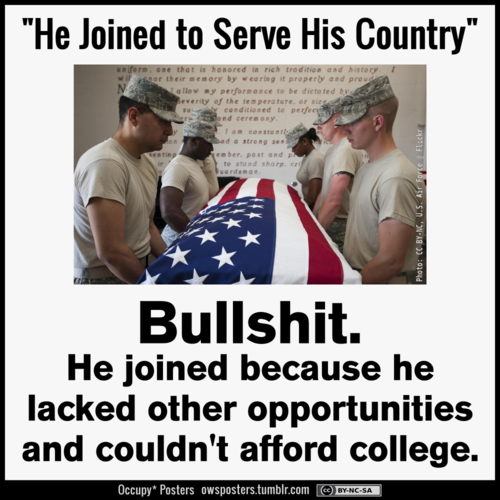
The military is actually serving corporations with a world-wide security force. Together with arms manufacturers, the military provides a massive jobs program. It's really about rewarding corporations. For kids just out of school, it is sometimes about the only job option. Unemployment probably helps recruitment a lot. We have a poverty draft.
Military buildup to various pointless wars was devastating to the US economy, our civil liberties, and most likely will end any meaningful benefits that we came to expect from our Constitution. State sponsored violence will not make you safer.
The Constitution has been undermined by giving covert agencies a free hand (denying the Congress the power of the purse.) Judicial rights have been undermined. (The US is now a country that feels free to torture its prisoners.) The US is also number 1 in incarcerations. The Bill of Rights undermined. The Congress made a serious mistake when it gave the President the power to make war.
Congress is ineffective in oversight of dark agencies, and it is
questionable whether the system is still self-correcting. Lobbyists are in
the revolving door and many are themselves felons. By packing the
judiciary with political hacks, Bush Jr assured that his abuses will
go without the checks and balances that were built into the Constitution.
The US now meets all of the criteria for a fascist state: readiness for a strong dictator,
a government that grossly violates human
rights,
corporate control of all branches of government, degraded civil liberties as a result of the
"Patriot Act", the large bureacracy that
is the national security state,
a military that takes resources from all other public purposes,
media that has all of the qualities of journalism that we deplored in Pravda, sham elections, a corporate oligarchy that rules
for their own profit, and an expanding empire.
The US thumbed its nose at international
law including the Geneva Convention, the Kyoto treaty, the treaty on land mines, the ABM
treaty, the treaty on weapons in space, and does not support the UN.
The end of the US Constitutional Republic is near, Republicans will probably get their apocalypse.
The
Military-Industrial Complex
Timeline of US Military Operations
Top five questions to ask the Pentagon
'The US Military is Exhausted' (12/26/2009)
Death Spiral at the Pentagon (2/2/2009) Chalmers Johnson
How the military-industrial complex is destroying America (video)
10 Conservative Myths About National Security
The US Has 761 Military Bases Across the Planet, and We Simply Never Talk About It (9/8/2008)
The US Military's Middle East Crusade for Christ
|

America's Medicated Army --U.S. troops
are going into battle with a different kind of weapon, one so
stealthy that few Americans even know of its deployment. 05 Jun
2008 For the first time in history, a sizable and growing number of
U.S. combat troops are taking daily doses of antidepressants to
calm nerves strained by repeated and lengthy tours in Iraq and
Afghanistan. The medicines drugs are intended not only to
help troops keep their cool but also to enable the already strapped
Army to preserve its most precious resource: soldiers on the front
lines. Data contained in the Army's fifth Mental Health Advisory
Team report indicate that, according to an anonymous survey of U.S.
troops taken last fall, about 12% of combat troops in Iraq and 17%
of those in Afghanistan are taking prescription antidepressants or
sleeping pills to help them cope. Escalating violence in
Afghanistan and the more isolated mission have driven troops to
rely more on medication there than in Iraq, military officials
say.
GAO Blasts Weapons Budget
http://www.truthout.org/docs_2006/040108A.shtml
(April 1, 2008)
Writing for the Washington Post, Dana Hedgpeth reports: "Government
auditors issued a scathing review yesterday of dozens of the
Pentagon's biggest weapons systems, saying ships, aircraft and
satellites are billions of dollars over budget and years behind
schedule. The Government Accountability Office found that 95 major
systems have exceeded their original budgets by a total of $295
billion, bringing their total cost to $1.6 trillion..."
Military waste is at horrendous levels. See the Washington Post's take here. (02/01/2008)
Yet healthcare for the troops is not a high priority. It isn't for the rest of us either.
Ongoing problems at Walter Reed
Veterans Without Health Care: The New York Times | (November 9, 2007)
http://www.truthout.org/docs_2006/111007C.shtml
In an editorial, The New York Times says that "many Americans
believe that the nation's veterans have ready access to health
care, that is far from the case. A new study by researchers at the
Harvard Medical School has found that millions of veterans and
their dependents have no access to care in veterans' hospitals and
clinics, and no health insurance to pay for care elsewhere."
Are Bush and Cheney out of control ?
Budget: Highest Military Spending Since World War II
President Bush's 2009 budget would increase spending on the military to $515 billion -- and this number doesn't even count the billions the U.S. is spending every day in Iraq. The White House says the military budget - again not counting spending on Iraq - has grown by 70 percent since President Bush took office. Keep checking our website for updated analysis of the federal budget.
Blackwater
Military Families Speak Out is an Organization of people opposed to the war in Iraq who have relatives or loved ones in the military. Formed by two families in November of 2002, we have contacts with military families throughout the United States and in other countries around the world. Our membership currently includes over 3,000 military families, with new families joining daily.
Veterans For Peace is a national organization founded in 1985 that includes men and women veterans from World War II , Korea , Vietnam , the Gulf War, other conflicts and peacetime veterans. Our collective experience tells us wars are easy to start and hard to stop and that those hurt are often the innocent. Thus, other means of problem solving are necessary. Veterans for Peace has a national office in Saint Louis , MO and members across the country organized in chapters or as at-large members.
See also:
Video
Why We Fight (video 1:38. Watch it on-line. It's important.)
On The Line:
(Movie about the School of the Americas )
Bibliography
Trump and His Generals: The Cost of Chaos: Peter Bergen
All Hell Breaking Loose: The Pentagon's Perspective on Climate Change: Michael Klare.
The Decline and Fall of the American Republic Bruce Ackerman
The Pentagon's Brain: Annie Jacobsen
Base Nation, How U.S. Military Bases Abroad Harm America and the World:
David Vine
House
of War, the Pentagon and the Disastrous Rise of American Power:
James Carroll
Reconsidering the Rules For Space Security (download this pdf)
Blank
Check: The Pentagon's Black Budget: Tim Weiner
Why We Lost: Daniel Bolger
Prophets of War: William Hartung
The Shadow World, Inside the Global Arms Trade, Andrew
Feinstein
Bomb Power, Gary Wills
The Theory of the Drone: Gregoire Chamayou
The Three Trillion Dollar War: Joseph Stiglitz and Linda Bilmes
Swords into Dow Shares: Rachel Weber
A Political Odyssey, the Rise of American Militarism and One Man's Fight to Stop It Mike Gravel With Joe Lauria Foreword by Daniel Ellsberg
U.S. vs Them: J. Peter Scoblic "conservative foreign policy... has increasingly undermined American security, most strikingly in the area of nuclear proliferation, where the Bush administration’s bellicosity has spurred a new arms race among nonnuclear powers."
The Complex, How the Military invades our everyday lives: Nick Turse
Blackwater, the Rise of the World's Most Powerful Mercenary Army: Jeremy Scahill