Secrecy
... we have repeatedly seen that secret law actually distorts the decision making process and it often produces bad policy that cannot stand the light of day. The clandestine endorsement of torture or coercive interrogation as official policy is proof of that. STEVEN AFTERGOOD, DIRECTOR, PROJECT ON GOVERNMENT SECRECY FEDERATION OF AMERICAN SCIENTISTS, WASHINGTON, D.C.
The Patriot Act inverts the constitutional requirement that people's lives be private and the work of government officials be public; it instead crafts a set of conditions in which our inner lives become transparent and the workings of the government become opaque. Either one of these outcomes would imperil democracy; together they not only injure the country but also cut off the avenues of repair. Elaine Scarry
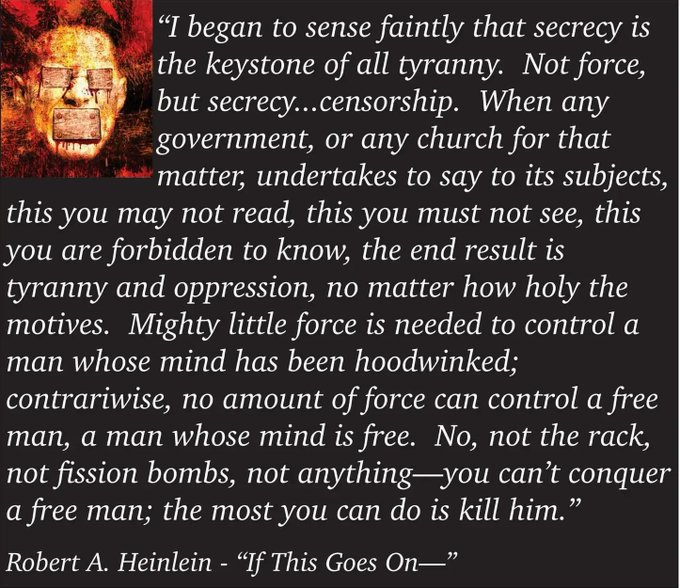
It doesn't seem to occur to anyone to ask what the implications are that an occult intelligence bureaucracy funded at $52 billion a year by your and my tax dollars keeps our elected leaders in the dark about its activities. Juan Cole, Informed Comment (10/28/2013)
"The liberties of a people never were, nor ever will be, secure when the transactions of their rulers may be concealed from them . . ." —Patrick Henry
"...Secret executive agreements that make commitments of unknown magnitude; presidential warmaking and bombing hooded in secrecy; escalation by stealth in Vietnam in the teeth of bleak intelligence estimates not disclosed to the nation; “White House Horrors”—the words are those of John Mitchell, former partner and Attorney General of President Nixon—spreading a miasma of encroachments on individual rights. These events have confirmed Patrick Henry’s warning that secrecy In government is an “abomination”; it is a main instrument in the corruption and arrogation of power. If the nation has not relearned that lesson from the secret escalation in Vietnam, from the bold attempt to corrupt the electoral process that surfaced in Watergate, it is unteachable. ...Another lesson to be learned from the past forty years of implicit trust in the wisdom of the President is that he, no less than Congress, may prove sadly deficient in vision." From the conclusion of Executive Privilege, a Constitutional Myth by Raoul Berger (1974)
hundreds of documents including activity logs, schedules, speech notes and three pages of handwritten notes from then-White House chief of staff Mark Meadows -- paperwork that could reveal goings-on inside the West Wing as Trump supporters gathered in Washington and then overran the US Capitol, disrupting the certification of the 2020 vote. The records could answer some of the most closely guarded facts of what happened between Trump and other high-level officials, including those under siege on Capitol Hill on January 6. House panel asks Supreme Court to say by mid-January whether it's taking Trump's January 6 records case (12/23/2021)
Links
Government Accountability Project
National Whistleblowers Center
Advocates For Accountable Democracy
Freedom of the Press Foundation
fucking shocked to learn that the guy who kept his grades secret and kept his medical records secret and kept his tax returns secret and kept his Putin transcripts secret also kept his Jan 6th phone records secret. how the fuck did we Nazi this coming
— Jeff Tiedrich (@itsJeffTiedrich) April 3, 2022
Secrecy continues to shield the NSA from uncomfortable questions about the growing role of the agency and its contractors in data mining and the burgeoning field of cybersecurity. The only way the American public ever learns what the NSA is doing to them is from whistleblowers, including, most recently, former NSA contractor Edward Snowden, who leaked documents about the rise of the NSA's massive data-mining operations during the Obama administration. To keep the war on terror going, the government has tried to make sure that whistleblowers are isolated and ostracized." James Risen: Pay Any Price: Greed, Power, and Endless WarIn a new interview, Reality Winner says leaking classified info was to serve the American people.
— Ricky Davila (@TheRickyDavila) December 6, 2021
It was to expose MAGA treason and I thank her for it every day. She needs to be pardoned.The architects of power in the United States must create a force that can be felt but not seen. Power remains strong when it remains in the dark; exposed to the sunlight it begins to evaporate. Samual Huntington
There must be some really damaging grand jury testimony Trump's DOJ is hiding. https://t.co/s2SUBU0Jz2
— Elizabeth de la Vega (@Delavegalaw) September 16, 2019"...without congressional action or a strong judicial precedent, I would _strongly_ recommend against anyone trusting their private data to a company with physical ties to the United States. Sincerely, Ladar Levison Owner and Operator, Lavabit LLC" (message announcing the closing of his email business.)When information has been classified to cover up corruption, that should be illegal. Exposing it laudable.
— Robert Vogel (@robert_vogel) September 20, 2019
Reality Winner revealed Russian medaling in elections but is now in jail. She is a hero and should be released.https://t.co/95mRixtpO2 https://t.co/QFinHknLE7"Why did the presidents and their men get the Soviet economy so wrong, and why were they so confident that they were right ? They supposedly had access to the best intelligence of all about the Soviets, that is, secret intelligence. The problem with this intelligence, Moynihan began to suspect, was precisely that it was secret...Proceeding from these secret assessments of Soviet strength rather than from the openly available facts about the sorry state of the Soviet Union, the Carter and Reagan administrations went on history's greatest peacetime weapons spending spree, and in six years (1982-88) the United States transformed itself from the world's greatest creditor nation into the leading debtor "while we're not disintegrating" Moynihan wrote in 1990, "we clearly blew an extraordinary economic lead." From the introduction to Secrecy by Daniel Patrick Moynihan.
Secrecy, a dagger in the heart of democracy, has hidden government activities that people would never approve as well as the pretext for pointless wars. and removed the possibility of accountability. Civil liberties are evaporating.
Having failed to learn lessons from history, we went to war in Iraq based on secret, twisted information. The same people, some felons, who justified the massive and dysfunctional arms buildup in the Reagan administration also were responsible for twisting 'intelligence' to justify the war in Iraq. Although media is complicit in keeping Americans ignorant about these facts, Congress, unwilling or unable to access classified information, failed in its oversight of the executive branch. Secrecy will likely be a fatal poison for the US Constitution.
People have a right to know what the law is. However, we now know that there is a body of secret law that richly illustrates US corruption.
Secret law should not be valid. Neither should secret trade agreements like the TPP.
Covert agencies with secret, undisclosed budgets continue to operate in ways that Americans would never approve. They are (and ought to be) unconstitutional.
Government relies upon a mix of carrots and sticks to control the press—promises of enhanced or special access, and threats of exclusion, even prosecution. There have been appeals to patriotism, efforts at suppression, self-censorship, propaganda, and intimidation. An administration that has been intent upon spreading democracy around the globe has shown little regard for transparency at home. It has secretly paid journalists to promote its agenda and planted stories in the Iraqi press. It has emasculated the Freedom of Information Act, reversing its presumption of openness. It has shut down access to all manner of records and even culled the past at the National Archives. Senior officials have felt free to belittle journalists who show the temerity to ask tough questions.
...
In May 2006, ABC News claimed that calls made by its reporters and others at the New York Times and Washington Post were being traced by the government in an effort to track down leaks of classified information. Many government sources, perhaps most, no longer feel comfortable speaking to reporters on the phone, especially when the subject is even remotely sensitive. Those kinds of worries on the part of reporters and sources alike have taken their toll on journalism and on what Americans may learn of their government.
“The administration wants journalism stopped,” Rep. James A. McDermott, a Washington Democrat, charged on the House floor on May 9, 2006. “It just gets in the way of the administration telling people only what they want them to know. .. . They know that secrecy is the fastest, most effective way to silence dissent.”
Such efforts to suppress news and keep secrets under wraps has severely tarnished America’s image abroad. Today, five journalists have been detained in American detention centers—four Iraqis are being held in Iraq and one Sudanese, an Al Jazeera cameraman, is at Guantanamo. None has been charged with a crime. The Committee to Protect Journalists says the United States now ranks sixth in the world for the number of reporters behind bars—a tie with the repressive regime of Myanmar (formerly Burma).
Many overseas news organizations and their audiences are convinced that the U.S. military deliberately targets foreign newsmen to suppress the news and keep a lid on information. In November 2001, the United States dropped two 500-pound bombs on Al Jazeera’s bureau in Kabul, Afghanistan. Five years later, the Pentagon still has not responded to the Committee to Protect Journalists’ call for an investigation into the strike.
On April 7, 2003, as Al Jazeera reporter Tariq Ayub was broadcasting live from the organization’s Baghdad bureau, a missile fired from a U.S. jet slammed into the building, killing him instantly. Nation of Secrets: Ted Gup
Chelsea Manning: 'I struggle with the so-called free world compared with life in prison' (10/22/2022)
Julian Assange Faces Ruling on Extradition to U.S. (1/3/2021)
ACLU Demands Secret Court Hand Over Crucial Rulings On Surveillance Law (10/22/2016)
The open source revolution is coming and it will conquer the 1% - ex CIA spy (6/19/2014)
The Terrible Toll of Secrecy (2/15/2014)
Secret Ops and Self-Government Don't Mix (12/23/2013)
James Clapper, EU Play-Acting and Political Priorities (7/3/2013)
The NSA's Intelligence-Industrial Complex (6/24/2013)
Glenn Greenwald on the High Cost of Government Secrecy (4/26/2013)
Obama's Crackdown on Whistleblowers (3/26/2013)
Death To Whistleblowers ? (3/14/2013)
Bradley Manning: A Tale of Liberty Lost in America (12/2/2012)
Wikileaks and Free Speech (8/21/2012)
The Pentagon's New Power Elite: A Secret War in 120 Countries (8/4/2011)
The National Security Complex and You (7/19/2012)
Assange Asks Ecuador For Asylum (6/19/2012)
Free Bradley Manning
Manning deserves Nobel Peace Prize
Eight Things You Need to Know About WikiLeaks (9/9/2011)
Punishing Whistleblowers who report waste (5/19/2011)
WikiLeaks: uses the internet to publish secret documents that someone thought should be made public. Why do we not know what our government is really doing ?
An interview with Wikileak's Julian Assange (7/30/2010)
Secret Government (5/8/2008)
The Largest Covert Operation in CIA History
Whistleblowers might, formerly, have provided corrections, but they are vigoriously prosecuted now and that is yet another reason why we can no longer have reliable journalism.
Fisa Fiasco, Continued
Firedoglake liveblogs the House debate. Read more »
Abu Ghraib Files - Salon
Bush's Martial Law Plan Is So Shocking, Even Congress Can't See It --Executive uber alles as member of Homeland Security Committee barred from viewing post-terror attack provisions By Paul Joseph Watson 23 Jul 2007 President [sic] Bush's post-terror attack martial law plan is so shocking that even sitting members of Congress and Homeland Security officials are barred from viewing it, another example of executive uber alles and a chilling portent of what is to come as constant reminders of the inevitability of terror attacks reverberate... Since [Rep. Peter] DeFazio (D-OR) also sits on the Homeland Security Committee and has clearance to view classified material, the request would have appeared to be routine, but the Congressman was unceremoniously denied all access to view the documents, and the White House wouldn't even give an excuse as to why he was barred.
Bush Administration Ramps Up Secrecy
t r u t h o u t | 09.10.07 http://www.truthout.org/docs_2006/091007A.shtml
William Fisher reports for Truthout: "The Bush administration is continuing its campaign to keep the public in the dark about the federal government's policies and decisions and to suppress discussion of those policies, their underpinnings, and their implications. This is the conclusion reached in the latest annual 'report card' on government secrecy compiled by OpenTheGovernment.org, a coalition of consumer and good government groups, librarians, environmentalists, labor leaders, journalists, and others who seek to promote greater transparency in public institutions."
- Government Accountability Project
- Secrecy News
- Open the Government.org
- Secrecy Blog
- Bush Secrecy
- James Madison Project
- Electronic Privacy Information Center
- Federation of American Scientists- Project on Government Secrecy
- Open Secrets
- Reporters Committee for Freedom of The Press
- The Electronic Frontier Foundation
- The National Security Archive At George Washington University
- The OMB Watch Government Information Page
- The OMB Watch Home Page
- Government Attic
- Public Intelligence
- National Archives
- Access Reports. http://www.accessreports.com
- Open the Government
- Privacy Times. http://www.privacytimes.com
- National FOI Coalition. http://nfoic.org
- beSpacific. http://www.bespacific.com
- The Brechner Center for Freedom of Information. http://brechner.org
- Coalition of Journalists for Open Government. http://www.cjog.net
- Cryptome. http://www.cryptome.org
- DocumentCloud
- CIA
- Electronic Frontier Foundation. http://www.eff.org
- Electronic Privacy Information Center Open Government Page. http://www.epic.org/open_gov
- Federation of American Scientists Secrecy Project. http://www.fas.org
- The Freedom of Information Center.
- The Memory Hole. http://www.thememoryhole.org
- National Security Archive. http://www.gwu.edu/~nsaarchiv
- OMB Watch. http://ombwatch.org
- OpenTheGovernment.org http://www.openthegovernment.org
- OpenLeaks
- Project on Government Oversight. http://pogo.org
- Public Citizen FOI Clearinghouse. http://www.citizen.org/litigation/free_info
- The Reporters Committee for Freedom of the Press. http://www.rcfp.org
- The Right-to-Know Network (RTK NET). http://rtknet.org
- Society of Professional Journalists. http://spj.org/foi.asp
- Sunlight Foundation http://www.sunlightfoundation.com
- Sunshine in Government Initiative. http://www.sunshineingovernment.org
- Top Secret America (10/24/2011)
- Transactional Records Access Clearinghouse (TRAC). http://trac.syr.edu
- Get My FBI file
Video
The Secret Government - the Constitution in Crisis
Secrecy (film 2008)
638 Ways To Kill Castro (a British film)
Federal Government Sites
- Department of Justice Office of Information and Privacy. http://www.usdoj.gov/oip/oip.html
- The Information Security Oversight Office (ISOO). http://www.archives.gov/isoo
- U.S. Government Portal. http://www.usa.gov
- Congress.gov
- Thomas. http://thomas.loc.gov
- PACER. http://pacer.psc.uscourts.gov
Bibliography
The Declassification Engine: What History Reveals About America's Top Secrets by Mathew Connelly
Data and Goliath, The Hidden Battles to Collect Your Data and Control Your World: Bruce Schneier
Reclaiming Accountability: Transparency, Executive Power, and the U.S. Constitution by Heidi Kitrosser
SECRET LAW AND THE THREAT TO DEMOCRATIC AND ACCOUNTABLE GOVERNMENT
Aspen-Brown Report (pdf)
Democracy in the Dark: The Seduction of Government Secrecy: Frederick A.O. Schwarz Jr.
This Machine Kills Secrets: Andy Greenberg
Top Secret America: The Rise of the National Security State: DanaPriest and William Arkin
Nation of Secrets: Ted Gup
Secrets: A Memoir of Vietnam and the Pentagon Papers: Daniel Ellsberg
Lost History: Robert Parry
Government Secrecy: Decisions Without Democracy: David Banisar (Download from the link.)
Secrecy: Daniel Patrick Moynihan.
Ghost Plane: Stephen Grey
Secrets, Lies, and Democracy by Noam Chomsky.
The Secret Government: Constitution in Crisis. A PBS Documentary.
Escalating secrecy wars. Punish leakers of classified documents severely, says CIA veteran
The Secret Government, the Constitution in Crisis: Bill Moyers
Secrets: On the Ethics of Concealment and Revelation: Sissela Bok
The Open Source Everything Manifesto: Robert David Steele See his video. or this link.
