“Fascism should more appropriately be called corporatism
because it is a merger of state and corporate power.” Mussolini
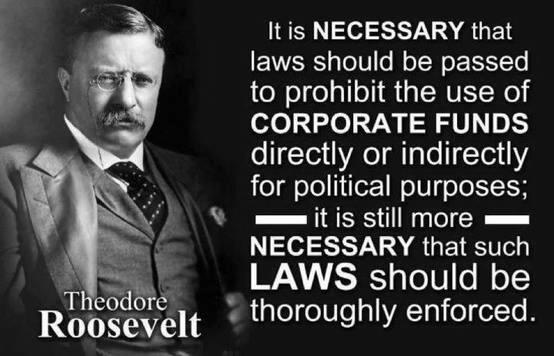
"All contributions by corporations to any political committee or for any political purpose should be forbidden by law."
Theodore Roosevelt
[Stock] Buybacks were illegal throughout most of the 20th century
because they were considered a form of stock market manipulation.
But in 1982, the [Reagan] Securities and Exchange Commission passed rule 10b-18,
which created a legal process for buybacks and opened the floodgates
for companies to start repurchasing their stock en masse.
... “Stock buybacks have been a prime mode of both concentrating income among the richest households
and eroding middle-class employment opportunities,”
William Lazonick, a professor at the University of Massachusetts Lowell, recently told CNN Money. Corporate stock buybacks are booming, thanks to the Republican tax cuts
(3/22/2018)
"We have reached the point in the United States where
corporatism has nearly triumphed over democracy. If events continue
on their current trajectory, the ability of our government to
respond to the needs and desires of humans - things like fresh
water, clean air, uncontaminated food, independent local media,
secure retirement, and accessible medical care - may vanish
forever, effectively ending the world's second experiment with
democracy. We will have gone too far down Mussolini's road, and
most likely will encounter similar consequences, elements of which
we have already experienced: a militarized police state, a
government unresponsive to its citizens and obsessed with secrecy,
a ruling elite drawn from the senior ranks of the nation's largest
corporations, and war." From Thom Hartman's book
Threshold pg 202
Corporations write our legislation. They control our
systems of information. They manage the political theater of
electoral politics and impose our educational curriculum. They have
turned the judiciary into one of their wholly owned subsidiaries.
They have decimated labor unions and other independent mass
organizations, as well as having bought off the Democratic Party,
which once defended the rights of workers. With the evisceration of
piecemeal and incremental reform—the primary role of liberal,
democratic institutions—we are left defenseless against
corporate power. Chris Hedges
"You live in a world today in which there is this perverse
system -- the more corporations pay their CEOs the lower their tax bill is." Senator
Chris Murphy
The purpose of the corporation has become perverted,from serving the public interest
to serving the private interests of financial investors.
Ralph Estes. Let the Sun Shine In.
Originally, corporations existed as a public service. People would get together to build a bridge and they would be incorporated for that purpose by the state. They built the bridge and that’s it. They were supposed to have a public interest function. Well into the 1870s, states were removing corporate charters. They were granted by the state. They didn’t have any other authority. They were fictions. They were removing corporate charters because they weren’t serving a public function. But then you get into the period of the trusts and various efforts to consolidate power that were beginning to be made in the late nineteenth century. It’s interesting to look at the literature. The courts didn’t really accept it. There were some hints about it. It wasn’t until the early twentieth century that courts and lawyers designed a new socioeconomic system. It was never done by legislation. It was done mostly by courts and lawyers and the power they could exercise over individual states. New Jersey was the first state to offer corporations any right they wanted. Of course, all the capital in the country suddenly started to flow to New Jersey, for obvious reasons. Then the other states had to do the same thing just to defend themselves or be wiped out. It’s kind of a small-scale globalization. Then the courts and the corporate lawyers came along and created a whole new body of doctrine which gave corporations authority and power that they never had before. If you look at the background of it, it’s the same background that led to fascism and Bolshevism. A lot of it was supported by people called progressives, for these reasons: They said, individual rights are gone. We are in a period of corporatization of power, consolidation of power, centralization. That’s supposed to be good if you’re a progressive, like a Marxist-Leninist. Out of that same background came three major things: fascism, Bolshevism, and corporate tyranny. They all grew out of the same more or less Hegelian roots. It’s fairly recent. We think of corporations as immutable, but they were designed. It was a conscious design which worked as Adam Smith said: the principal architects of policy consolidate state power and use it for their interests. It was certainly not popular will. It’s basically court decisions and lawyers’ decisions, which created a form of private tyranny which is now more massive in many ways than even state tyranny was. These are major parts of modern twentieth century history. The classical liberals would be horrified. They didn’t even imagine this. But the smaller things that they saw, they were already horrified about. This would have totally scandalized Adam Smith or Jefferson or anyone like that….
Noam Chomsky
"A corporation is a tyranny. It’s the purest example
of a tyranny you can imagine: power resides at the top, orders are sent
down stage by stage, and at the very bottom, you have the option of
purchasing what it produces. The population, the so-called stakeholders
in the community, have almost no role in deciding what this entity
does. And these entities have been granted extraordinary powers and
rights, way beyond those of the individual. But none of it is graven in
stone. None of it lies in economic theory. This situation is the result
of, basically, class struggle, carried out by highly class-conscious
business classes over a long period, which have now established their
effective domination over society in various forms. But it doesn’t have
to exist, it can change. Again, that’s a matter of democratising the
institutions of social, political, and economic life. Easy to say, hard
to do, but I think essential." Noam
Chomsky
"Behind the ostensible government sits enthroned an
invisible government owing no allegiance and acknowledging no
responsibility to the people. To destroy this invisible government, to
befoul the unholy alliance between corrupt business and corrupt
politics is the first task of the statesmanship of the day." Theodore Roosevelt
(April 19, 1906)
"Wherever it has emerged over the past thirty-five
years, from Santiago to Moscow to Beijing to Bush’s Washington, the
alliance between a small corporate elite and a right-wing
government has been written off as some sort of
aberration—mafia capitalism, oligarchy capitalism and now,
under Bush “crony capitalism.” But it’s not an
aberration; it is where the entire Chicago School crusade with its
triple obsessions — privatization, deregulation and
union-busting—has been leading." Naomi Klein, Shock Doctrine.
"The country is headed toward a single and splendid
government of an aristocracy founded on banking institutions and
moneyed incorporations and if this tendency continues it will be
the end of freedom and democracy, the few will be ruling...I hope
we shall...crush in its birth the aristocracy of our moneyed
corporations which dare already to challenge our government to
trial and bid defiance to the laws of our country. I sincerely
believe that banking establishments are more dangerous than
standing armies."
Thomas Jefferson
Corporations are the engines of unfairness in the economy, propel wealth disparities,
authoritarian hierarchies that despise democracy, passionate opponents of labor unions,
extracting wealth to keep people down and in servitude, and a powerful force for authoritarian government.
The whole idea that monopolies are bad and needed to be curbed has been sort of lost by both Republicans and Democrats. Both parties have empowered monopolies. I would guess that most companies engage in price fixing of some sort. They tell you it's market dynamics. BS. https://t.co/Yl16AZYNEK
— Preserve Truth - I took a vow of silence, then.. (@truthtellerat) April 20, 2023
"After World War II, the nation's tax bill was roughly split between corporations and individuals. But after years of changes in the federal tax code and international economy,
the corporate share of taxes has declined to a fourth the amount individuals pay, according to the US Office of Management and Budget."
--Boston Globe series on Corporate Welfare
The top 5 corporate donors to the Sedition Caucus:
Johnson & Johnson (worth $400 billion) created a shell company in TX to hold all the liability for their carcinogenic baby powder, then filed for bankruptcy with the shell company. This is legal, because corporations write our laws. 38,000 women will go without a settlement
1) Corporations argue that their growth is just part of the free market. 2) Use their monopoly power to gouge consumers. 3) Take a portion of their profits to make political donations. 4) Lobby against antitrust enforcement. 5) Repeat.
...every major watchdog institution in the capital
city is controlled by corporations and their lobbyists, even though the
Constitution and other founding documents
do not mention the word "corporation." Lobbyists, "who are not here
just to look at the Washington Monument," now outnumber consumer advocates by more
than 100 to one, he said: Ralph Nader quoted in Presidential Puppetry
by Andrew Kreig
The top 5 corporate donors to the Sedition Caucus:
"Corporations argue that in order to function most
effectively, big business must manage workers'
performance through a top-down command structure. They never use the
word authoritarian to describe themselves, although they are very vertically autocratic, instead they cite the
'free market' as their disciplinarian." Ralph Nader: Breaking Through Power p34
Reminder that before 1982, stock buybacks were considered stock manipulation. Reagan's SEC opened the floodgates to their abuse.
Stock buybacks don’t create more jobs. They don't increase wages. They don’t grow the economy.
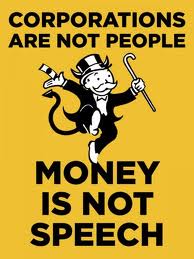
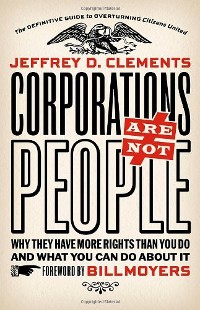
"corporations are not people.
People have hearts. They have kids. They
get jobs. They get sick. They thrive. They dance. They live. They love.
And they die. And that matters. That matters. That matters because we
don’t run this country for corporations, we run it for people." Elizabeth
Warren
In the 1930s it contributed to the rise of fascism. Alarmingly, we are experimenting again with a monopolized economy.
Amazon and online shopping didn’t kill Toys ‘R’ Us as many people had claimed. Private equity executives did. They bought the company, extracted assets and value out of it, lined their own pockets, then left us to crumble under a $5 billion debt. https://t.co/NCYbRs9Mhl
Corporate power is at a zenith in America, and business has privileges not
seen since the Gilded Age. Executives make more money than ever. Corporate profits are
at record highs. The courts are expanding corporate rights, as companies exert great political power and dominate our
policy discourse. But the most valuable perquisite corporate officers possess is the ability to commit
crimes with impunity. Such injustice threatens American democracy."
The chickenshit club: why the Justice Department fails to prosecute executives, Jesse Eisinger.
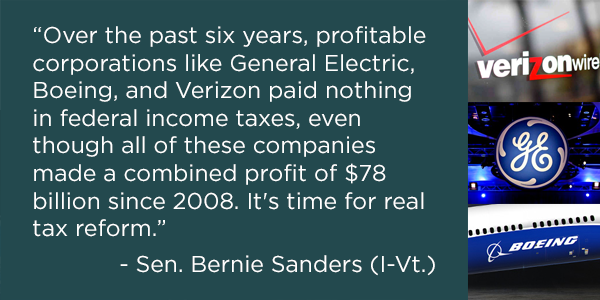
Amazon CenturyLink Chevron Deere Delta Air Lines Eli Lilly FedEx Gannett General Motors Goodyear Honeywell JetBlue MGM Resorts Netflix Prudential Financial Starbucks Whirlpool
Total federal income tax paid by these companies last year: $0
Private equity firms want you to believe you’re not smart enough to understand their business model. But it's pretty simple: take over companies & loot 'em.
...[The] "corporation enjoys the same rights as a living
person under Fourteenth Amendment to the Constitution. This concept was
held in 1886 by the Supreme Court in Santa Clara County v. Southern
Pac Railroad Company and has been a fact of law ever since ... I
emphasized... the corporation should be required to accept the same
responsibilities as those expected of a person; it too should be a
good citizen, an honorable, ethical member of the community. In the
case of international corporations, that community has to be
defined as the world.
In actual practice, corporations are the opposite of good
citizens. They bribe politicians to write laws that cheat society
on a mammoth scale, most significantly by allowing them to avoid
paying many of the very real costs incurred in conducting their
businesses. What economists refer to as “externalities”
are left out of pricing calculations. These include the social and
environmental costs of destruction of valuable resources,
pollution, the burdens on society of workers who become injured or
ill and receive little or no health care, the indirect funding
received when companies are permitted to market hazardous products,
dump wastes into oceans and rivers, pay employees less than a
living wage, provide substandard working conditions, and extract
natural resources from public lands at less- than-market prices.
Furthermore, most corporations are dependent on public subsidies,
exemptions, massive advertising and lobbying campaigns, and complex
transportation and communications systems that are underwritten by
taxpayers; their executives receive inflated salaries, perks, and
“golden retirement parachutes,” which are written off
as tax deductions." John Perkins: The Secret History of the
American Empire
To recap 1. Airlines spent 96% of free cash on stock buybacks for a decade 2. They got a $50 billion bailout & cut 90,000 jobs anyway 3. They returned to billions in profits, paid back $0 to taxpayers & raised ticket prices 16% 4. They canceled the 2nd-most flights ever this year
"Oddly, no previous management research has looked at
what the legal literature says about the topic, so we conducted a
systematic analysis of a century’s worth of legal theory and precedent.
It turns out that the law provides a surprisingly clear answer:
Shareholders do not own the corporation, which is an autonomous legal
person. What’s more, when directors go against shareholder wishes—even
when a loss in value is documented—courts side with directors the vast
majority of the time. Shareholders seem to get this. They’ve tried to
unseat directors through lawsuits just 24 times in large corporations
over the past 20 years; they’ve succeeded only eight times. In short,
directors are to a great extent autonomous." Harvard
Business Review: The Myth of Shareholder Capitalism
"...this empire that we’ve created really has an emperor,
and it’s not the president of this country. The President
serves, you know, for a short period of time. But it doesn't really
matter whether we have a Democrat or a Republican in the White
House or running Congress; the empire goes on, because it’s
really run by what I call the corporatocracy, which is a group of
men who run our biggest corporations. This isn’t a conspiracy
theory. They don’t need to conspire. They all know what
serves their best interest. But they really are the equivalent of
the emperor, because they do not serve at the wish of the people,
they’re not democratically elected, they don’t serve
any limited term. They essentially answer to no one, except their
own boards, and most corporate CEOs actually run their boards,
rather than the other way around. And they are the power behind
this." From John Perkins interview
with Amy Goodman June 5, 2007
"Great corporations exist only because they are
created and safeguarded by our institutions; and it is therefore our
right and our duty to see that they work in harmony with these
institutions." Theodore
Roosevelt 1901
" The most effective way to restrict democracy is to
transfer decision-making from the public arena to unaccountable
institutions: kings and princes, priestly castes, military juntas,
party dictatorships, or modern corporations." Noam
Chomsky
"The power of our private managers over our public servants
was exemplified by the ability of business lobbyists to persuade
Congress to nullify the 1993 attempt by the Financial Accounting
Standards Board (FASB) to require stock options to be expensed in
corporate earnings statements. In June 1993, Senator
Joseph Lieberman introduced a bill
condemning the FASB’s attempt, which passed the Senate
overwhelmingly. He later introduced a side bill that would have put
the FASB out of business if it implemented its option-expensing
initiative. The FASB had little choice but to retreat, a sad
example of legislation interfering in accounting decisions." John
C. Bogle in The Battle for the Soul of Capitalism pg 39
"Despite the much vaunted Corporate Responsibility Act and
the highly publicized round up of a few of the most heinous offenders,
the awful truth is that the corporate tricksters have pillaged the
U.S. economy and gotten away with it. They're still living in their
gargantuan houses, still feasting on their wildly inflated
salaries, and engorging themselves on staggering sums of stock
options, while the rest of America tries to figure out how to
rebuild for retirement. or send a kid to college on a worthless
stock portfolio." Arianna
Huffington, Introduction to Pigs
at the Trough: How Corporate Greed and Political Corruption are
Undermining America (2003)
"Corporations have been enthroned and an era of corruption
in high places will follow, and the money-power of the country will
endeavor to prolong its reign by working upon the prejudices of the
people until all wealth is aggregated in few hands and the republic
is destroyed." - Abraham Lincoln
"I hope we shall crush in its birth the Aristocracy of our
monied corporations which dare already to challenge our government
to a trial of strength, and bid defiance to the laws of our
country." Thomas Jefferson, 1816
Q: "What do you see as most fundamental obstacle to a
functioning and socially-just democracy in America?
Well the most pressing obstacle was one of the themes of the
leading American social political philosopher of the 20th century,
John Dewey. He pointed out that, as long as we live under what he
called industrial feudalism, rather than industrial democracy (by
industrial feudalism he meant the corporate, capitalist structure)
then politics will be nothing more than the shadow cast by business
over society. Industrial democracy would mean placing economic
decisions and workplaces under democratic control. And yes, that's
true. As long as there's a very high concentration of private
power, essentially unaccountable to the public and overwhelming
influence in state policy, then yes, politics will be the shadow
cast by business over society. That's a major obstacle. You can't
have a democratic society, a functioning one, where the major
decisions are out of public control." From an interview with Noam
Chomsky.
The requirement that corporations are legally
required to maximize shareholder profits over any other consideration
must be removed also, which is the worst law of all, permitting, in fact
inviting, hostile corporate invasion. Mary Lehmann
On January 21, 2010, the U.S. Supreme Court ruled that
corporations are entitled to spend unlimited funds in our
elections. The First Amendment was never intended to protect
corporations. This cannot stand. Join our campaign
to protest this decision. Protect our democracy! Free speech is
for people — not corporations.
U.S. corporations are intent on continuing — and
even expanding — foreign wars, low taxes for the wealthy, and
when needed, further bank/corporate bailouts. These policies
are incompatible with the current expenditures on social services,
education, and Social Security and Medicare — thus the
gigantic and expanding U.S. deficit. global
research: 4/15/2010.
Indeed, the function of the transnational corporation
is not to promote a healthy ecology but to extract as much
marketable value out of the natural world as possible even if it
means treating the environment like a septic tank. An
ever-expanding corporate capitalism and a fragile finite ecology
are on a calamitous collision course, so much so that the support
systems of the entire ecosphere---the Earth's thin skin of fresh
air, water, and topsoil---are at risk. It is not true that the
ruling politico-economic interests are in a state of denial about
all this. Far worse than denial, they have shown outright
antagonism toward those who think our planet is more important than
their profits. So they defame environmentalists as
"eco-terrorists," "EPA gestapo," "Earth day alarmists," "tree
huggers," and purveyors of "Green hysteria." Michael
Parenti
Of the World's 100 Largest Economic Entities, 51 are now
Corporations and 49 are Countries. (Institute for
Policy Studies 2000)
...every major watchdog institution in the capital
city is controlled by corporations and their lobbyists, even though
the Constitution and other founding documents do not mention the
word "corporation". Lobbyists, who are not here just to look at the
Washington Monument, now outnumber consumer advocates by more than
100 to 1" Ralph Nader at the National Press Club 2013.
"You live in a world today in which there is this perverse
system -- the more corporations pay their CEOs the lower their tax bill
is." Senator
Chris Murphy
¨Big companies hoard wealth and influence. They fuel inequality. They despoil the planet.
They don’t pay their taxes."[David Runciman, How Democracy Ends.]
The U.S. is an oligarchy
because corporations have become too powerful. States compete to give them taxpayer money so that they might provide
jobs. Their lobbyists successfully got Republicans to provide them with massive tax cuts adding $1.5 trillion to the debt.
When Republicans are in office debt doesn't matter.
Because corporate media is reliably right-wing, Republican Presidents are like teflon: Trump can do no wrong.
Neither could Reagan. LIke most Republicans they represent corporatists.
What we have lost is reliable media, sensible healthcare, consumer protection,
public lands, public transit, safe infrastructure, affordable education, democracy.
and our republic.
Elected billionaires despise democracy.
Deceitfulness: repeated lying and conning of others for
profit [or for your own interests];
Incapacity to experience guilt;
Failure to conform to social norms with respect to lawful behavior [as in failure
to abide by international law].
Since big money controls media (and Congress),
we get only corporate news. Mussolini (and
some dictionaries) defined fascism as
control of the government by corporations. We've got that.
Corporations in every industry tend to consolidate and in doing so eliminate competition,
downsize number of jobs, reduce quality, and
almost always raise prices. They operate in secret,
make heavy use of non-disclosure agreements, and funnel dark money to
politicians. Much of their activity does not stand the light of day.
It is the nature of corporations to consolidate. In practically
every industry consolidation has resulted in less competition, more
expensive service, downsized work force, increased lobbying, more income inequality, and oligarchy. Free markets
need competition, but corporate concentration all but eliminates it. As
a result we have culture-destroying media that
cannot support democracy, the most expensive healthcare
in the world, a massively expensive military-industrial complex,
internet speeds that are not near as good as South Korea,
newspapers in steep decline, big box retailers
destroying downtowns, ...
When Republicans deregulated,
what they did was allow corporations
to do almost anything that they wanted. What we got was a carnival
of corruption including massive theft from companies like
Enron, Tyco, Worldcom, with complicity from Arthur Anderson, major
banks, brokerages. In addition, these same Corporations bought
political favors, special legislation, pollution permits, tax
breaks, access that allowed them to control the agencies that
were supposed to be regulating, they crashed the market, and then were
bailed out by the taxpayers.
Corporate representatives were inducted into regulatory
agencies to further serve their industries...not the people. For example,
see Robert F Kennedy's book "Crimes
against Nature".
Banks nearly wrecked our own and the world economy because
oversight was all but eliminated. Collusion with bond raters, the
elimination of Glass-Steagle, and lobbying for deregulation allowed
corruption that nearly took down the economy. Next time it will be
worse because banks are even bigger and more powerful now.
Trade agreements, like the TPP,
are not so much about trade as they are about corporate power grabs.
Multinationals have become peers of government and are, arguably, even
more powerful than nations.
In 2004, because Republican
partisans manufacture voting machines
they took the election, then because they
controlled the Congress there was no
oversight, because they own the media they installed right-wing cheerleaders for war.
We went to war in Iraq on false pretexts and there was
no accountability for war profiteering.
Corporate profits soared. The military-industrial complex
rules. The National Security State
was affirmed. Militarism is yet another blow to democracy.
Wal-Mart is a prime example of a monopsonist:
a company which is such a powerful buyer that it can pressure its
suppliers into suicidal terms. The only way suppliers could meet
Wal-Mart's demands was by moving manufacturing to third world
countries. The US has lost 3 million manufacturing jobs since the
beginning of the Bush regime. Not only has
Wal-Mart helped strip the manufacturing base from this country, the
US trade deficit has soared, and overseas
sweatshops have flourished. It's not all bad though, we
exported the pollution associated with manufacturing abroad as
well.
Wal-mart
has devastated thousands of small towns,
forced factories to migrate off-shore,
vigorously opposed labor
unions. pushed their minimum wage employees onto the public
dole, strained public health facilities. Those low prices are
not without cost. See Wal-Mart.
Before Ronald Reagan there might have been anti-trust
enforcement for Wal-Mart,
but ...Republicans don't enforce
anti-trust. It's part of their race for the bottom.
According to the Supreme Court, Corporations only responsibility is shareholder profit, which is why they
tend to be sociopaths. Representative democracy cannot survive well-funded interference by special interests, which has
brought us to a reincarnation of fascism.
US corporate governance
needs re-examination. Workers are not represented (as they are in
Germany). Tax dodging is rampant. CEOs rip
the red meat from their companies. There is a
revolving door between government and the private sector which
everyone is rewarded...except the public. Free trade agreements, like
the TPP, can make corporations more powerful than governments. Yet
another wound for democracy.
Governments run by corporations are, by definition, fascist.
A Message from John
Perkins: Corporations first obligation should be to be good citizens.
For the U.S. to continue as a democracy,
Corporations need oversight so that they are good citizens. That is why regulation,
despite what Republicans say, is a must.
Ronald Reagan gutted anti-trust enforcement and helped
corporations bust unions. (Did you know the
right to form a union is part of the UN Declaration of Human Rights
?)
Yesterday
I had a post on
how K Street is no longer shunning Democrats. Thomas
Frank explains the significance of the K Street Project in the
New York Times:
K Street is not neutral. From all its complex machinations
emerges a discernible political project best described by Joseph
Goulden in “The Superlawers” back in 1972, when the
lobbying business was so many acorns beside today’s forest of
towering oaks. The “Washington lawyers,” Goulden wrote,
had over the years “directed a counterrevolution unique in
world economic history. Their mission was not to destroy the New
Deal, and its successor reform acts, but to conquer them, and to
leave their structures intact so they could be transformed into
instruments for the amassing of monopolistic corporate
power.” (Goulden, by the way, is no radical: he is a former
director at the very conservative press watchdog Accuracy in
Media.)
K Street’s bright young men fill the top posts at federal
agencies; K Street’s money keeps wages low and prescription
drug costs high; K Street’s “superlawyers” fight
to make our retirement insecure; K Street’s deregulation
gurus turn our electric utilities into the plaything of Wall
Street. What K Street wants from government is often the opposite
of what the public wants. And yet what K Street wants, far too
frequently it gets — if not by the good offices of Bob Ney,
then by the timely disappearance of the now useless Bob Ney.
Whether we are Republicans or Democrats, we are all aware of
how
much more power corporations hold over everyday life than they used
to. “Those who own the country should govern the
country,” John Jay used to say, and thanks in large part to K
Street they do.
Written by Ron Chusid
Condoleezza Rice comes to mind. "The United States,"
she said, "is determined to keep an international focus on the
travesty that is taking place in Burma." What she is less keen to
keep a focus on is that the huge American company, Chevron, on
whose board of directors she sat, is part of a consortium with the
junta and the French company, Total, that operates in Burma's
offshore oilfields. The gas from these fields is exported through a
pipeline that was built with forced labour and whose construction
involved Halliburton, of which Vice-President Cheney was chief
executive. From John Pilger (the Guardian
10/27/2007)
Better pay can be an incentive for better performance. Much as
Republicans favor this concept,
there ought to be some limitations
dictated by common sense.
Examples: When Merrill Lynch revealed a
$7.9 billion loss on subprimes in 2007. It fired its CEO, Stanley
O'Neal, but not without giving him $161.5 million parting gift
first. The same happened for ex-Citigroup CEO Chuck Prince, who
walked with $140 million. Even as $17.5 billion disappeared from
Citigroup's books in just six months. And $34.6 billion vaporized
from Citigroup's outstanding shares. These are enterprises too big
to fail, so, though it is kept quiet, there'll be considerable
taxpayer money used to keep them solvent. And so it goes. There are
many others and they point to problems in corporate governance. Are
these examples of pay for performance ?
CEOs that rip the red meat from their
companies have become a commonplace in the US. It is but one more
of the symptoms that substantial
reform of corporate governance should be a high priority. There should
be severe limitations on corporate control of media...particularly
news
media. There
should be strong cross-ownership laws that, for example, forbid
defense contractors from owning media companies.
An aggressive program leading to
shareholder
democracy would be a good start. Workers should always be
represented on the Board as they are in Germany. A highly graduated
income tax would solve many
problems.
New Internet Tool for Executive Pay Comparisons: The Securities
& Exchange Commission launched its on-line tool that enables
comparison of executive compensation for major corporations. https://www.sec.gov/xbrl
See https://www.faireconomy.org/reports/2006/ExecutiveExcess2006.pdf
for the Institute for Policy Study’s 13th Annual CEO’s
Compensation Survey titled “Defense and Oil Executives Cash
in on Conflict.” It notes that since 9/11, the average pay
for the 34 top military contractors has increased from $3.6 million
to $7.2 million. While the average army private makes
$25,000/year, the average military contractor CEO makes $7.7
million.